

Eco-friendly Innovation
綠色創新
Technical Challenges at Hsinchu Seawater Desalination Plant: How to Prevent Biofouling at Intake Facilities Without Adding Chemicals?

The Hsinchu Seawater Desalination Plant serves as a flagship project of Taiwan’s efforts in developing large-scale desalination infrastructure and strengthening regional water supply resilience. It is Taiwan’s first desalination plant with a daily production capacity of 100,000 CMD. By integrating international desalination expertise with a local engineering team, CTCI (the project contractor) has prioritized the minimization of environmental and ecological impacts throughout the design, construction, and long-term operation and maintenance phases. While conventional desalination plants typically use chemical dosing at seawater intake facilities to prevent biofouling—the attachment of marine organisms to intake pipes—this article explores how the CTCI team achieves the same inhibitory effect without using chemicals. This approach reduces environmental impact, aligning with the company’s corporate vision of acting as a "guardian of global sustainability."
Project Back Ground
Hsinchu area serves as a vital hub for Taiwan’s technology industry. The thriving industries in Hsinchu Science Park have driven a continuous rise in the demand for water—both for domestic and industrial consumption. In recent years, global climate change has led to an increased frequency of extreme rainfall and drought events. This has resulted in widening disparities between high and low river flow rates within catchment areas, posing a severe challenge to the stability of traditional water supplies.

To address water supply risks during the dry season and strengthen regional water supply resilience, the government has planned to build a seawater desalination with a capacity of 100,000 CMD, next to Nanliao Fishing Harbor, serving as a vital safeguard for a stable water supply in the Hsinchu area.

The construction of the Hsinchu Seawater Desalination Plant will not only enhance water supply adaptability in the face of extreme climate conditions but also ensure water security for both the general public and the high-tech industry; it serves as a landmark project in Taiwan’s efforts to diversify water sources and strengthen the resilience of the water supply for its high-tech industrial corridors.
Maintenance Optimization for Seawater Intake Pipelines and Pigging Implementation
Seawater intake pipelines are critical to desalination plants, yet they are highly susceptible to biofouling. Marine organisms—such as barnacles, mussels, and algae—can attach themselves to the pipe wall causing reduction internal diameter and obstruction water flow. It forces pumps to work under a heavier load, which increases energy consumption, lowers operational efficiency, and compromises the stability of downstream pretreatment processes and reverse osmosis (RO) systems. If this situation is not fixed, biofouling can also negatively impact the quality of the desalinated water.

Traditional maintenance methods for seawater intake pipelines often rely on chemical agents—specifically, "shock chlorination." This process involves dosing the system with a sodium hypochlorite solution at a concentration of 5 to 10 ppm, performed several times a day for durations of up to five minutes for each time. Beyond its adverse impact on marine biological communities, this chemical approach has another significant drawback: once initiated, it must be maintained continuously throughout the entire O&M stage of the seawater desalination plant. This is because sodium hypochlorite is only effective against barnacles during the early stages of their life cycle. This traditional maintenance method not only disrupts the marine ecosystem but also fails to align with long-term, environmentally friendly maintenance goals. To mitigate the impact of maintenance activities on the marine environment, CTCI has implemented a "pigging" maintenance method—an innovative approach to maintaining seawater intake pipelines at desalination plants in Taiwan.

This method employs a mechanical pig—a device propelled through the water intake pipeline by the flow of seawater—to remove accumulated deposits from the pipe walls, with the pig subsequently retrieved at the outlet. Compared to traditional chemical cleaning, this mechanical pigging approach effectively replaces or reduces the need for chemical agents, thereby preventing issues related to chemical residues and the environmental impact of discharging such substances into the marine ecosystem. Furthermore, it ensures the intake pipeline remains clear, mitigating the risk of operational inefficiency or system failure. By adopting this maintenance strategy, CTCI has transitioned the maintenance of seawater intake facilities from "chemical inhibition" to "mechanical removal," achieving a balance between operational stability, maintenance efficiency, and environmental stewardship of the marine ecosystem.
Introduction to Pigging System and How It Works
Pigging systems are widely used in the oil and gas industry and, over the past two decades, have also been applied in seawater desalination plants. Pigging is a method of pipeline cleaning that does not require the use of chemical agents. By using the water flow with a specialized tool known as a "pig," biological growth, sediments, and marine organisms adhering to the inner walls of the pipes can be scraped off and flushed out into the sea. In seawater desalination plants, the pig is inserted at the pipeline inlet (called “lunch pipe”), and retrieved at the outlet(located in the sea), keeping the pipes clean and minimizing the impact of biofouling on operational efficiency.
What are the advantages of pigging technology?
⦁ Enhance transport efficiency: Reduce deposits within the pipes, improve water flow, and lower pump energy consumption.

⦁ Maintain stable operation: Reduce operational issues and the risk of shutdown caused by biofouling.

⦁ Reduce the use of chemical agents: Replace chemical treatments with mechanical cleaning to lower environmental impact.

⦁ Extensive practical experience: The relevant technology has been applied to seawater desalination and water utility facilities worldwide.

Pigging operations involve inserting a pig into a seawater intake pipeline (at the launch station) and using the force of the water flow to propel it through the pipe, until the pig pushes any debris to the other end of the pipeline (the receiving end/outlet) for discharge.

Typically, pigging operations are conducted once or twice a year, with the exact frequency depending on the extent of pipeline scaling or production losses. In most cases, the operation proceeds from the seashore toward the offshore, which is the reverse direction of the normal operation.

The loading and launching of the pig takes place on the shoreside. This not only allows for better utilization of existing equipment and logistical resources but also reduces the diving operation work. Furthermore, this direction ensures that the large volume of debris cleared during the pigging process is pushed directly out of the pipeline and into the open sea, thereby saving the time otherwise required to remove such debris from within the intake chamber. In addition, the design of the launch station and intake chamber, which is the launch and reception points for the pig, must be well-suited for pigging operations. This is crucial for streamlining the pigging process and minimizing operational downtime.
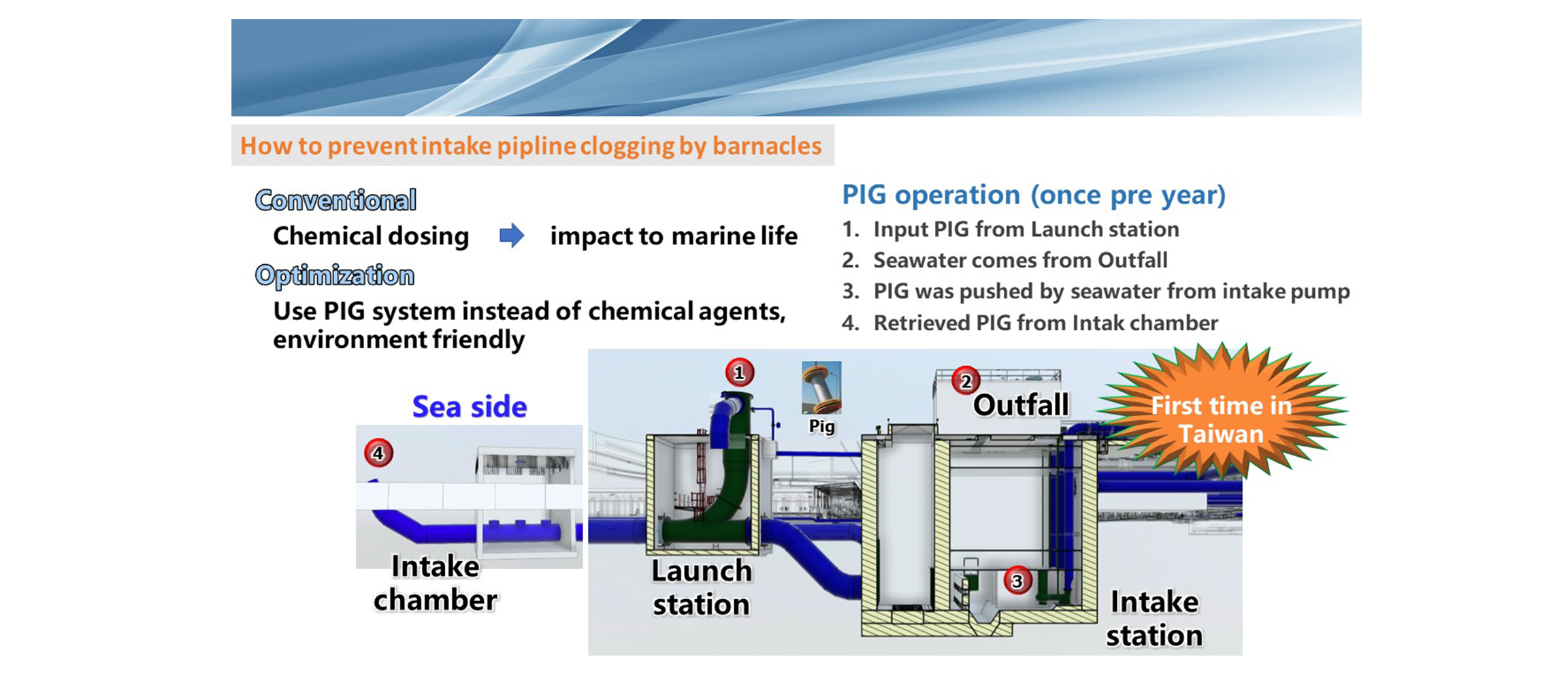
Figure 1 Piping system operation
Conclusion
Pigging operations utilize flowing seawater to propel a "pig" through a pipeline, effectively removing biofouling without the need for chemical agents, thereby maintaining the transport efficiency of water intake systems. Compared to using oxidizing agents, this technique also minimizes the impact on marine life and reduces costs associated with the use of chemicals.

By incorporating technologies that balance operational efficiency with environmental protection, CTCI consistently integrates the concept of "green engineering" into its project practices. This approach allows the company to meet facility operational requirements while minimizing environmental impact, advancing toward engineering solutions that are safer, more eco-friendly, and sustainable.


