

Sustainable Governance
永續治理
Engineering at a New Dimension: Building the Core Engine of Sustainable Value

As the wave of AI sweeps across industries worldwide, CTCI is responding to this transformation through its core engineering expertise. In 2026, the Group officially ushered in its “Inaugural Year of AI,” deeply integrating artificial intelligence into governance and decision-making, green engineering, and everyday sustainability practices. ESG is no longer simply a responsibility; it is also an engine driving efficiency and innovation. This transformation did not emerge overnight. CTCI has long focused on green engineering, smart applications, and the circular economy, connecting the sustainability value chain from design through operations with its iEPC capabilities. As a result, CTCI has consistently achieved the highest score in the global construction and engineering industry group in the Dow Jones Best-in-Class Indices and has ranked among the top 1% globally in S&P Global's Sustainability Yearbook year after year. At this pivotal moment, CTCI is bringing together the momentum of AI and sustainability to open up a new dimension for engineering.
Global Trends: A New Landscape in the Age of AI
Global demand for energy and infrastructure is rising rapidly. According to the International Energy Agency’s (IEA) World Energy Investment 2026 report, published in May 2026, global energy investment is expected to reach US$3.4 trillion in 2026, of which US$2.2 trillion will go to clean energy—nearly twice the investment in fossil fuels. The IEA’s Electricity 2026 report also projects that global electricity demand will grow at an average annual rate of 3.6% from 2026 to 2030, 2.5 times the rate recorded since 2015. Expanding electricity demand from data centers and artificial intelligence (AI) applications is a key driver. PwC estimates that the annual global infrastructure investment gap will widen from US$4.4 trillion in 2024 to US$6.9 trillion in 2050, while investment in data-center-related infrastructure is projected to increase by as much as 121% between 2024 and 2027. With climate change, the energy transition, and the AI wave unfolding in parallel, the engineering industry must do more than meet growing construction demand: it must also address energy supply, emissions reduction, resource efficiency, and infrastructure resilience.

CTCI’s three business development directions are green engineering, smart applications, and the circular economy. Through intelligent engineering, procurement, and construction (iEPC), CTCI integrates engineering expertise with sustainability capabilities and continues to develop and apply AI and other emerging digital technologies. These efforts help clients improve energy efficiency, reduce carbon emissions and resource consumption, and strengthen infrastructure and supply-chain resilience. From gas-fired power plants, LNG terminals, high-tech facilities, and rail transportation to reclaimed-water projects, carbon capture, utilization and storage (CCUS), and seawater desalination, CTCI continues to extend its engineering expertise to meet the needs of the energy, industrial, and environmental sectors, providing engineering solutions that support industrial development, decarbonization, and resilience.
Connecting the Core: Strengthening Sustainability Through AI
As the scope of sustainability issues continues to expand, CTCI has strengthened governance integration through organizational adjustments. The Board-level Sustainable Development Committee was renamed the ESG & Net Zero Committee in 2021 and upgraded to the Sustainability and Information Security Committee in 2025, bringing sustainable development, net-zero emissions, and information security into a unified governance framework. The Group also established the Sustainability and Net Zero Office, led by the Chief Sustainability Officer (CSO), to coordinate strategy development and implementation and report progress to the Group President every month, creating a top-down management and feedback system. To accelerate the practical application of AI and digital technologies in the sustainability transition, CTCI’s Research & Innovation Center evaluates the feasibility of applying technologies such as AI and robotic process automation (RPA) to projects. It also leads the adoption of digital twins and robotics while continuously improving the performance of core operations systems. At this pivotal point in the engineering industry’s transformation, competitive advantage depends not only on technical capabilities but also on the ability to integrate smart technologies with sustainability responsibilities. Guided by this principle, CTCI combines ESG and AI to strengthen decision-making and resource efficiency, helping both the Group and its clients reduce the environmental impacts of their operations.
ESG for Everyone: Embedding Sustainability in Our DNA
In 2025, CTCI upgraded its existing “ESG Moment” to “ESG × AI Moment.” In addition to continuing its goal of “starting from our core business, engaging every employee in ESG, and embedding sustainability in our DNA,” the Group incorporated AI into sustainability practices to demonstrate cross-disciplinary innovation, and has continued to deepen this initiative in 2026. CTCI also encourages employees to put sustainability into practice through their professional work. Since 2022, the Group and the CTCI Education Foundation have jointly organized the “CTCI Group ESG Award.” Now in its fifth year, the award continues to recognize initiatives under the themes of “Environmental Action” and “Social Impact,” while adding the “Sustainability Ambassador” and “ESG × AI Digital Application Award” categories to encourage employees to identify tangible sustainability contributions and innovative applications in their daily work.

To understand employees’ current sustainability knowledge and capabilities, the Sustainability and Net Zero Office launched a “Sustainability Literacy Survey” in 2025. The results indicated room to further strengthen employees’ understanding of emerging international sustainability topics, including diversity, equity and inclusion (DEI), the Science Based Targets initiative (SBTi), biodiversity, and sustainable supply chains. In response, CTCI introduced 32 selected courses from CommonWealth Sustainability Academy this year. The courses cover six learning areas: sustainability trends and knowledge, the circular economy, net-zero learning, a diverse and inclusive workplace, biodiversity, and sustainable social impact. At the end of the year, the Group will also hold “Sustainability Mini-Class” activities with an incentive mechanism, encouraging employees to select courses according to their work needs and enhance their sustainability expertise.

The “CTCI POWER GO” initiative, launched during Environment Month, is also being expanded and deepened. This year, it calls on employees across the Group to participate through three themes: “Zero Carbon Power: Emissions Reduction Action,” “Zero Waste Power: Circular Action,” and “Zero Distance Power: Shared Prosperity Action.” These themes cover energy conservation and emissions reduction at work and in daily life, resource recycling and reuse, and the use of AI and digital tools to improve efficiency and foster a culture of shared prosperity. A lucky draw further encourages participation, helping move sustainability from advocacy into everyday life and gradually building momentum for change.
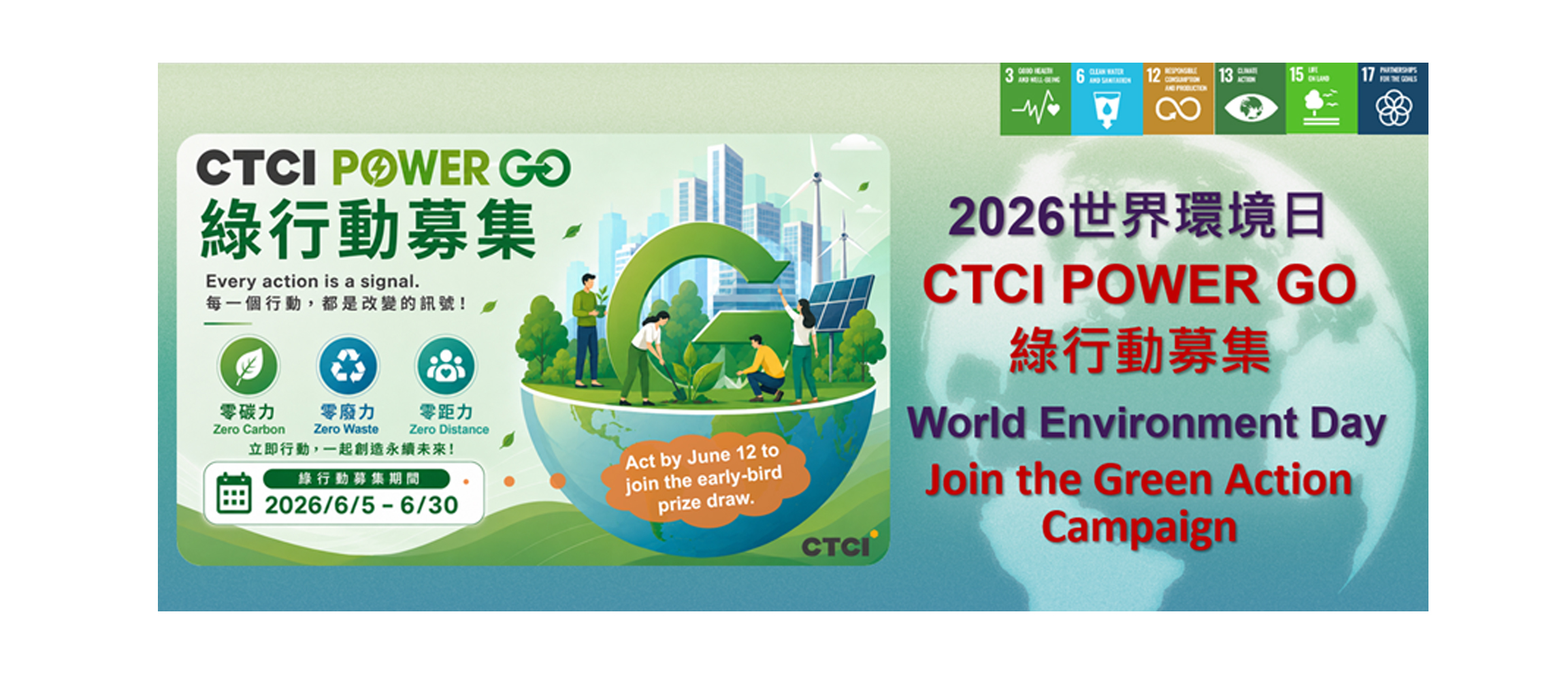
CTCI POWER GO
In the area of social engagement, CTCI has established the “CTCI Group Volunteer Service Management System,” introducing volunteer passports and automated administration of its reward mechanism. The Group has also revised its Volunteer Service Hours Recognition Guidelines, making it easier and more efficient for employees to apply for volunteer service hours and review their personal volunteering records. By documenting each act of service, CTCI and its employees continue to build lasting social impact through their shared commitment to public welfare and to serving as guardians of a sustainable Earth.
Guardians of a Sustainable Earth: Engineering Practice Powered by ESG and AI
The impact of CTCI Group’s sustainability transition through its core engineering business is reflected in the changing composition of its business. The contract value of green and low-carbon projects under construction increased from NT$43.8 billion in 2015 to NT$367.7 billion in 2025. Their share of total contracts also rose from 23% to 82%, representing an increase of 740%. As the expansion of AI applications drives demand for computing power, CTCI is further strengthening its capacity to build power infrastructure. It holds a 70% market share in Taiwan’s natural-gas combined-cycle power plant market and has expanded its integrated engineering services to AI data centers and semiconductor fabs. These services provide comprehensive solutions covering power, HVAC, and water and gas systems, incorporating “Zero-Waste Center” technologies to meet the needs of high-tech industries.

Building on its engineering track record, CTCI regularly reviews energy-saving solutions through its Sustainability and Net Zero Improvement Meetings. More than 250 specific measures have been developed to date and implemented in projects. The Group has also introduced its independently developed “CTCI Digital Twin” platform, integrating key data from design through operations and using AI and digital technologies to improve the accuracy and efficiency of engineering management. These efforts have delivered measurable environmental benefits. For projects built for clients between 2023 and 2025, operational-stage savings are expected to total 1.98 billion kWh of electricity—equivalent to the annual electricity consumption of 501,000 households; 17.4 million metric tons of carbon emissions avoided—roughly equivalent to the annual carbon absorption of 44,736 Da’an Forest Parks; and approximately 200 million metric tons of water saved, equivalent to 242 days of water use in Taipei. The Group is also investing in green projects such as reclaimed-water plants, bioenergy centers, and solar power plants, with total investment reaching NT$49.5 billion. In 2025, its energy and resource centers and solar facilities generated a combined 1.772 billion kWh of electricity, treated 2.9 million metric tons of waste and 111.246 billion liters of wastewater, and received a cumulative NT$10 billion in green finance support.

CTCI serves global high-tech companies, energy and infrastructure operators, and their supply-chain partners. In addition to continuing to expand in the Americas, Europe, and Asia, the Group has formed strategic alliances with Delta Electronics, the USI Group, and the Daya Group to pursue global opportunities in smart green engineering. CTCI has also joined forces with Hon Hai to advance the overseas development of “TEEMA Science Parks.” By integrating regional development, project management, and EPC capabilities, the initiative plans to develop high-tech industry clusters in locations including the United States, Mexico, Poland, and India. It aims to help Taiwanese companies establish local supply chains and build a resilient and sustainable global industrial footprint.
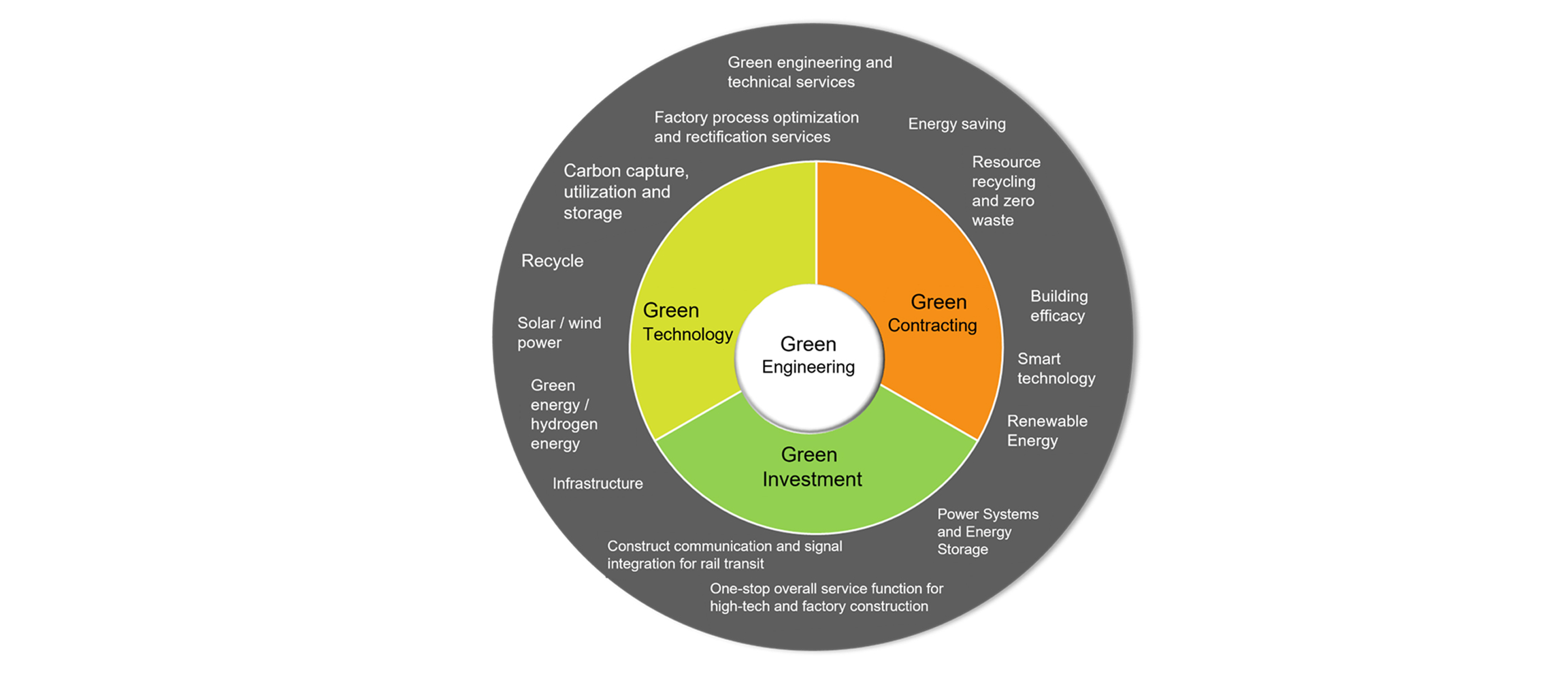
Leverage Our Core Business to Be a Guardian of Sustainable Earth
Green Commitments in Action: Steady Progress on the Path to Decarbonization
For greenhouse gas emissions reduction, CTCI has joined the Science Based Targets initiative (SBTi) and had its targets validated, establishing a decarbonization pathway aligned with the 1.5°C goal of the Paris Agreement. Using 2022 as the base year, CTCI has committed to reducing Scope 1 and Scope 2 emissions by 45% by 2030, exceeding the 42% reduction benchmark required by the SBTi. It has also committed to achieving 100% net-zero emissions at office locations by 2030 and across all locations by 2050, while setting an ambitious long-term goal of achieving net zero across the Group by 2045. In terms of actual progress, the emissions reduction rate reached 24.1% in 2025, surpassing the target of 12.6% set for that year and demonstrating tangible progress in the Group’s low-carbon transition.
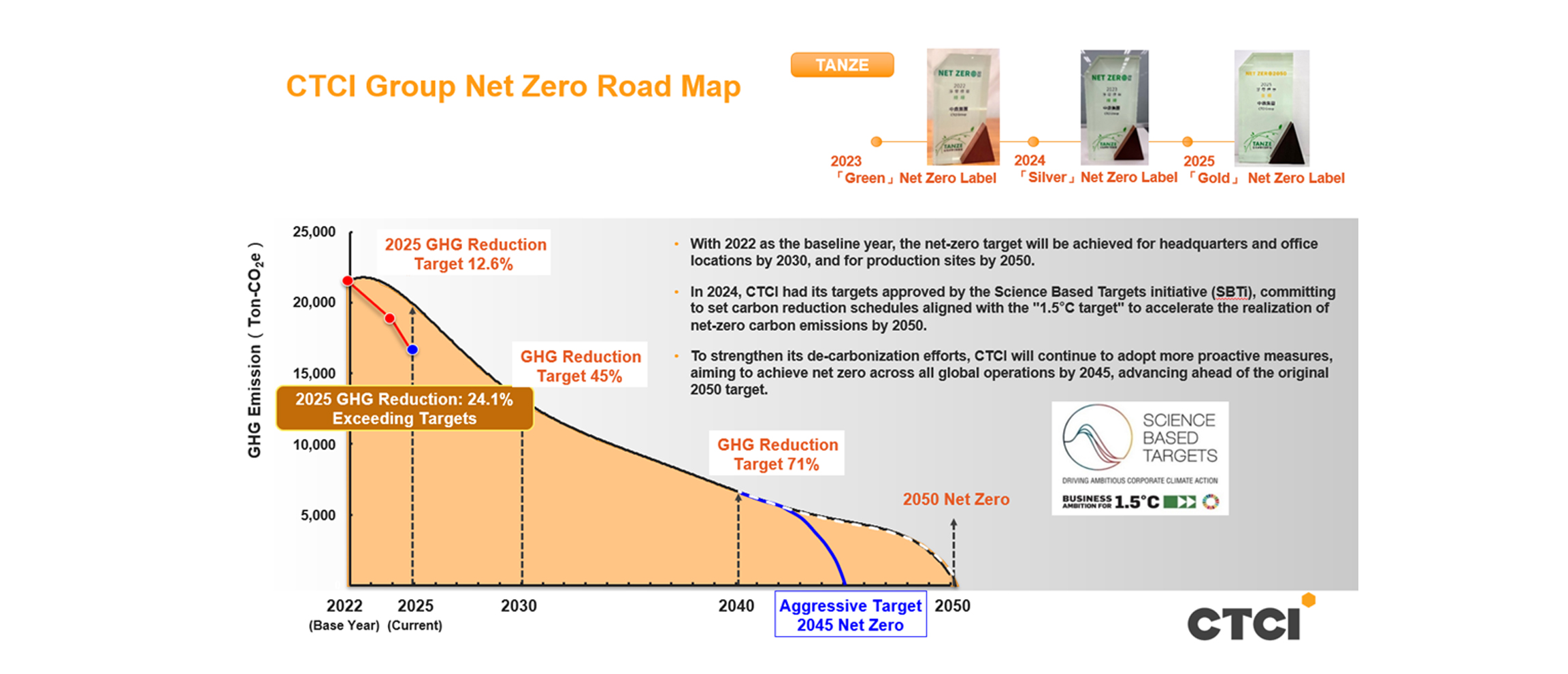
CTCI Group Net-Zero Roadmap
CTCI continues to monitor developments in carbon pricing in Taiwan and overseas and has adopted internal carbon pricing as a management tool to strengthen emissions-reduction performance. The internal carbon price was set with reference to international indicators, including the World Bank’s State and Trends of Carbon Pricing report and prices in the EU carbon market. Domestic developments and trends in Taiwan’s carbon fee were also considered, along with industry pricing approaches and implementation strategies. Based on an assessment of internal and external carbon costs at production and service locations, CTCI set its internal carbon price at US$100 per metric ton of carbon dioxide equivalent (tCO₂e). Through a shadow-price mechanism, carbon costs are incorporated into day-to-day operational management, encouraging business units to address the operational implications of carbon-emissions risks. This helps ensure that internal carbon pricing serves its management purpose, supports the implementation of emissions-reduction measures, and informs long-term low-carbon transition decisions.

To establish an industry benchmark for carbon-footprint management, CTCI developed Product Category Rules (PCR) for “engineering services” that support comparability and reproducibility, addressing the significant differences in the scale and nature of engineering projects. The PCR was reviewed by the Ministry of Environment and officially announced on September 18, 2025. CTCI subsequently completed its carbon-footprint assessment and management in accordance with the standard and obtained ISO 14067 carbon-footprint verification this year. The Group will use this basis to apply to the Ministry of Environment for a carbon label, providing more comprehensive quantitative information in response to clients’ and the market’s expectations for low-carbon engineering services.
Building on Our Core Business: The Next Step Toward Sustainability and Intelligence
From integrating governance structures and deepening sustainability action across the workforce to delivering green engineering results and honoring decarbonization commitments, CTCI has embedded sustainability as a core engine of its engineering business. In 2026, the Group officially launched its “Year One of AI,” with a research and development team of more than 100 people working to integrate AI into core engineering processes. It has set the challenge of “completing the design drawings for a plant in 30 minutes.” Through process automation and cross-system information integration, CTCI is gradually upgrading traditional EPC into intelligent plant solutions. For CTCI, however, AI is not a new theme that replaces sustainability; it is an accelerator that helps sustainability become reality—enabling more precise decarbonization decisions, more efficient resource use, and faster responses to the needs of the planet and clients through every engineering project. Looking ahead, CTCI will continue to advance green engineering, smart applications, and the circular economy, deepening the dual integration of ESG and AI. At this new dimension of engineering, CTCI will build sustainable value that combines efficiency with responsibility and work with employees and partners to create a world where net zero and smart development thrive together.


