Eco-friendly Innovation
綠色創新
Hsinchu Seawater Desalination Plant: A New Paradigm for Resilient Water Supply in Taiwan via Green Innovation
From Water Scarcity to Sustainable Resilience: The Strategic Mandate of Seawater Desalination
Climate change has rendered global precipitation patterns increasingly erratic. Despite its relatively high annual rainfall, Taiwan faces significant constraints in effective water storage due to its precipitous topography, short river systems, and reservoir sedimentation. With the rapid expansion of the high-tech industry, the Hsinchu Science Park—a cornerstone of the global high-tech supply chain—demands an escalating volume of water resources. Providing a stable water supply is not only critical to public livelihood but is also fundamentally tied to Taiwan’s overall industrial competitiveness.

Learning from historical drought events, it is evident that enhancing the resilience of Taiwan’s water infrastructure requires more than just demand-side water conservation. Relying solely on rainfall is insufficient to mitigate future uncertainties; therefore, augmenting supply—the "open-source" approach—must proceed in tandem with conservation efforts.

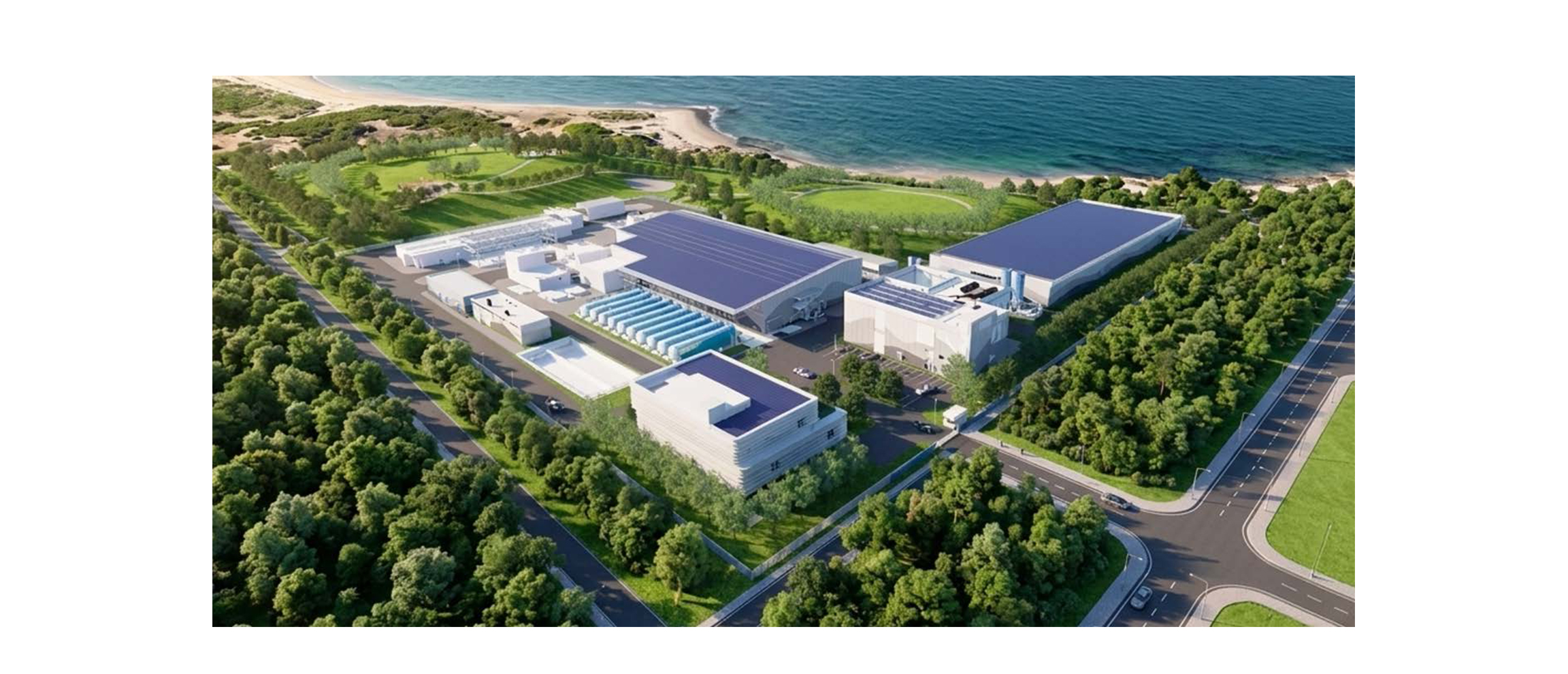
The CTCI Group, in collaboration with SUEZ (France) and HHC (Hung Hua Construction), has partnered with the government to spearhead a diversified water resource strategy. Through the contract for the "Construction and Operation & Maintenance of the Hsinchu Seawater Desalination Plant," the consortium is developing a facility in the Nanliao area capable of producing up to 100,000 tons of desalinated water per day. This project provides a reliable water source for both public use and high-tech industrial development, marking a pivotal transition in Taiwan’s water policy from "reliance on natural supply" to "proactive water resource creation."

The primary value of seawater desalination lies in its decoupling from seasonal precipitation. With access to seawater and energy, it ensures a consistent supply of freshwater. Rather than replacing existing reservoirs, this plant serves as a "resilient contingency" within the overall water supply network, diversifying the infrastructure and strengthening the nation's adaptive capacity against extreme climatic events.
Chapter 1: The Core of Green Innovation—Beyond Desalination
The Hsinchu Seawater Desalination Plant utilizes energy-efficient Seawater Reverse Osmosis (SWRO) processes, prioritizing safety, efficiency, and sustainability.

Seawater is drawn from an intake structure located approximately 1.6 kilometers offshore at a depth of 10 meters below sea level. The entire intake pipeline is subterranean, minimizing disruption to local fisheries while enhancing pipeline protection and extending its service life. The intake head is equipped with filtration systems to prevent large marine organisms and debris from entering the system, complemented by automated pigging systems that periodically clear biofouling and sedimentation to ensure hydraulic efficiency and operational stability.

Upon entering the facility, the seawater undergoes pre-treatment to remove algae, organic matter, and suspended solids, thereby stabilizing the influent quality. Advanced dual-media filtration—utilizing anthracite and sand—replaces traditional pressure-driven ultrafiltration membranes, balancing treatment efficacy with energy efficiency. Subsequent security cartridge filters remove particles larger than 5 microns, mitigating the risk of RO membrane fouling and extending their operational lifespan.

The heart of the facility is the two-stage RO system. High-pressure pumps drive the seawater through the membranes, allowing water molecules to permeate while retaining salts and impurities as brine. Simultaneously, Energy Recovery Devices (ERDs) capture the pressure energy from the concentrated brine and feed it back into the system, drastically reducing overall energy consumption and ensuring both a stable supply and operational sustainability.
Chapter 2: The Value of Green Innovation—Integrating Sustainability into the Facility Life Cycle
The green innovation of the Hsinchu Seawater Desalination Plant transcends the technical process, extending to site planning, architectural design, energy management, and landscape integration, embedding sustainability into the facility's entire life cycle.

To mitigate the impact of mechanical operations on the surrounding environment, the engineering team conducted acoustic modeling to optimize both equipment placement and building envelopes. The processing plant incorporates reinforced concrete, single and double-layer hollow wall panels, and composite metal facades, significantly improving the building's acoustic performance to minimize operational noise pollution for nearby residents.

The Administration Building serves as the facility's management hub and is designed in accordance with Green Building, Smart Building, and energy-efficiency standards, balancing occupant comfort with energy reduction. The facade features extensive horizontal shading louvers and Low-E double-glazing to reduce solar heat gain and alleviate cooling loads. The HVAC system utilizes multi-split variable frequency units, adjusting capacity based on real-time occupancy to maximize energy-use efficiency.

In terms of water resource management, the Administration Building directly utilizes the desalinated water produced on-site. Furthermore, a rainwater harvesting system collects runoff from the roof, which is processed via centrifugation and stored in underground cisterns for landscape irrigation and green space maintenance, optimizing water circularity.

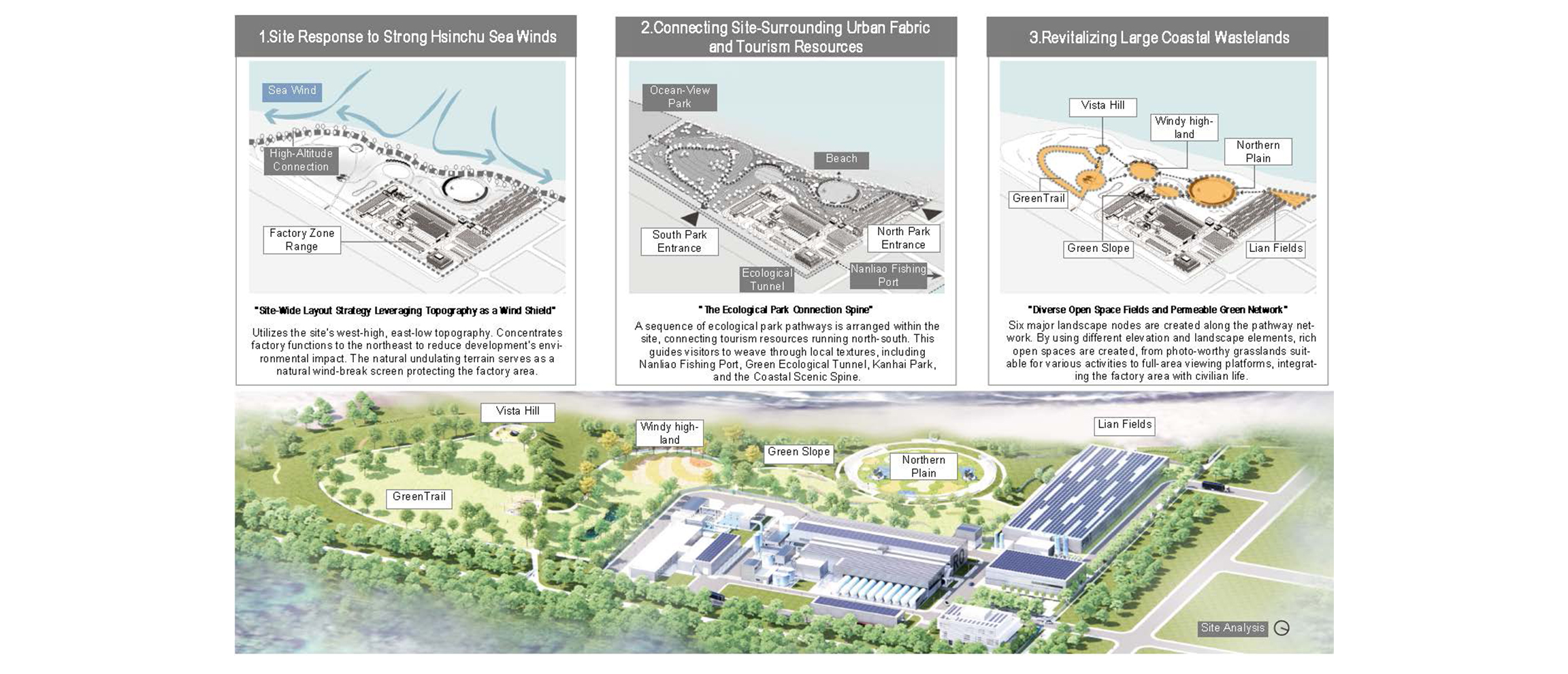
Regarding site master planning, the team balanced engineering requirements with natural preservation by concentrating the primary plant in the northeast, thereby minimizing the development footprint. This approach preserves the existing hills on the west and south sides as green zones. Adopting the principles of Low Impact Development (LID), the construction process prioritized the conservation of indigenous vegetation and existing ecosystems, minimizing habitat fragmentation.

The height of the facility's structures is controlled below the elevation of the surrounding hills, allowing the architecture to blend into the landscape and mitigating visual impact on the Hsinchu 17-kilometer coastline. A dry ecological detention pond is integrated between the southern hills and the plant, serving both as an environmental education site and a functional flood detention basin during extreme rainfall events to safeguard the facility.
Conclusion
The value of the Hsinchu Seawater Desalination Plant extends beyond its role as a water supply facility; it stands as a testament to the integration of green technological innovation into comprehensive facility design. From energy-efficient SWRO processes and energy recovery systems to LID principles and bioclimatic architecture, every optimization reflects the engineering team's commitment to achieving equilibrium between efficiency, environmental stewardship, and sustainability.

Looking forward, as extreme climate conditions become the new normal, infrastructure must strive for more than technical quality; it must embody resilience, decarbonization, and intelligent management. Seawater desalination will evolve from a standalone utility into a sustainable water resource system that integrates renewable energy, smart monitoring, and circular economy principles. Green innovation is not merely a breakthrough in isolated technologies; it is the implementation of sustainable principles into every engineering detail, ensuring that every drop of water carries a long-term commitment to the environment, society, and corporate governance (ESG).