
Technology
技術分享
The Application of New AI Technologies in Engineering
— Roger Yang, R&D Leader of Intelligent Innovation Department, CTCI Group Research & Innovation Center
The engineering industry is confronted with challenges of transformation due to global supply chain restructuring and the rapid iteration of technologies. CTCI not only deepens its own digital transformation, but also actively applies AI across all lifecycle stages of its projects to enhance its engineering services. In this article, we will share how CTCI turns “labor-intensive” engineering tasks into “intelligence-intensive” work and opens up a new chapter of enhanced productivity. This includes the application of Retrieval-Augmented Generation (RAG) technology, image recognition technology, and external AI tools.

Meanwhile, CTCI values sustainable corporate governance and ethics. It is committed to improving its employees’ "AI literacy" and building safeguards for AI applications, so that projects could be executed faster, better, smarter, and more efficiently through AI-driven, upgraded engineering services.
Challenges of the Engineering Industry and a Glimmer of Hope
Insufficient manpower and talent gap are among the primary challenges that the engineering industry faces today. As senior engineers retire, their know-how and experience are not easily passed on to younger engineers. Another challenge comes from the increased complexity in legal requirements and documents due to the growing scale of engineering projects. Faced with tight schedules and high cost, engineering companies find it harder to consolidate data and collaborate between fields of expertise.

These challenges serve as important entry points for introducing AI into engineering practices. Using AI to consolidate engineering data, extract useful insights, and support decision-making is exactly the core direction of CTCI’s AI applications.
Retrieval-Augmented Generation (RAG) Application: Extracting Key Contract Data
A contract is the ultimate guide that dictates how things should be done throughout the lifecycle of a large-scale engineering, procurement, and construction (EPC) project. However, international engineering contracts are often voluminous with complex and intertwined terms, requiring an enormous amount of time to review manually. There may even be risk of oversight that would bring serious consequences. To deal with this problem, CTCI developed an exclusive key contract data extraction system based on Retrieval-Augmented Generation (RAG) technology.

The core objective of this system is to deeply parse unstructured contract texts through AI technology and transform them into a semantic database that machines can understand, thereby providing intelligent Q&A services to assist project team members in efficiently organizing contract requirements. In terms of the application interface, the system not only supports a "Quick Ask" function for real-time queries on a single question, but also features a "Bulk Ask" module equipped with powerful batch processing capabilities, which can load multiple project checklists at once and produce corresponding answers, significantly improving contract review efficiency.
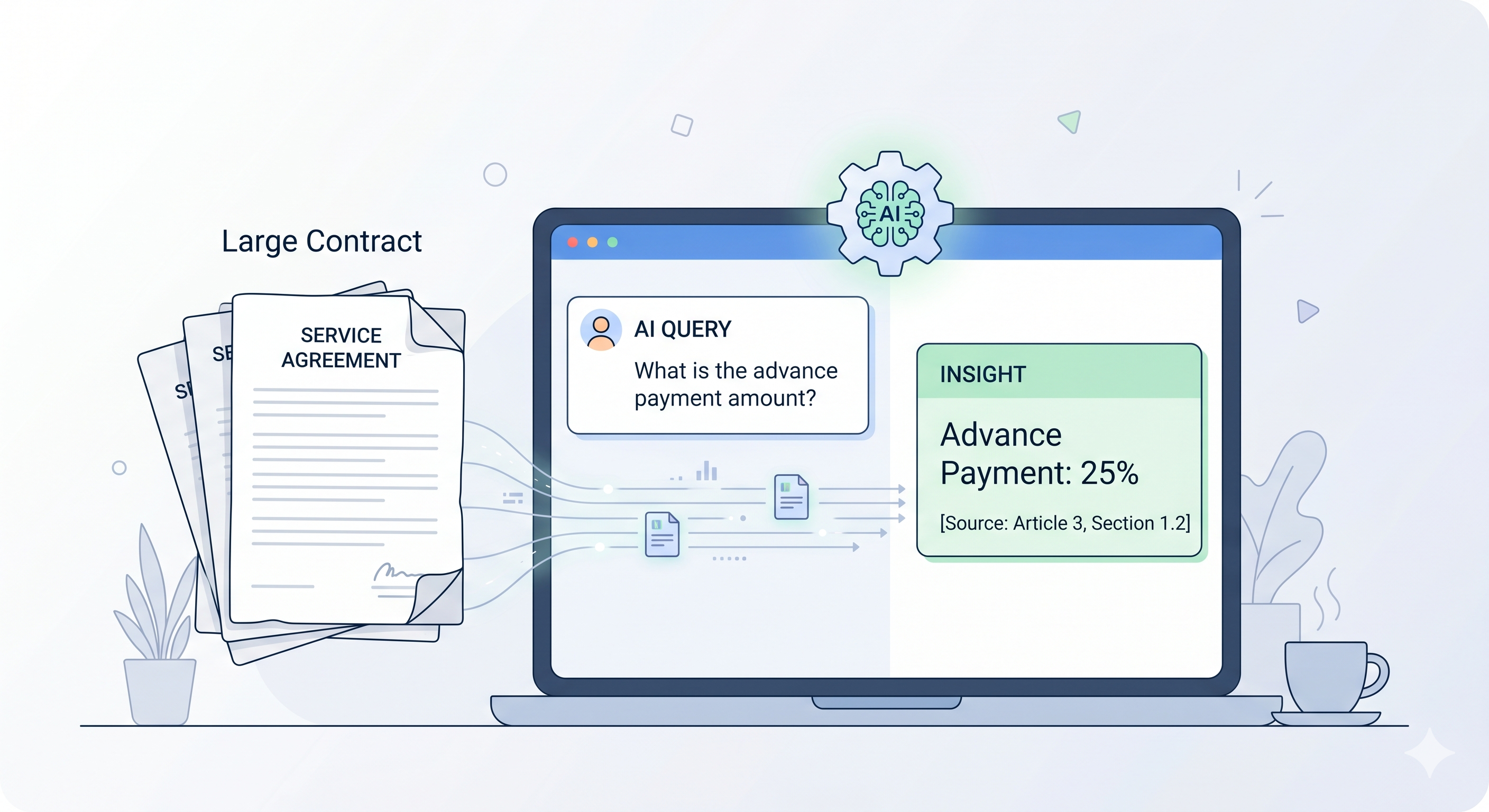
Illustration of the Key Contract Data Extraction System
Through queries, key contract information can be rapidly extracted to accelerate the contract review process. Furthermore, the high-precision retrieval capability of RAG technology effectively prevents the omission of important contract requirements, thus reducing losses or avoiding contract fulfilment disputes from manual review. The introduction of AI systems is akin to establishing a digital defense line, significantly reducing risks, and elevating the accuracy and comprehensiveness of contract management.

A thorough understanding of contract terms with the help of RAG technology accelerates preparatory work during the tendering and bid preparation phases. The extracted key engineering parameters and commercial terms also become a solid and unbiased contractual basis for subsequent detailed design, equipment procurement, and on-site construction inspections.
Image Recognition Application: Intelligent Parsing of P&ID Engineering Drawings
In complex turnkey engineering projects, Piping and Instrumentation Diagrams (P&ID) are not only the core of process design, but also the crucial basis for subsequent piping layout, equipment procurement, and plant construction. However, P&ID drawings for modern large-scale plants easily number in the thousands, and the drawings are densely packed with complex piping routes and professional symbols. Traditionally, data verification and transcription are done manually, which is inefficient and prone to misjudgment. To address this problem, CTCI applied AI image recognition technology to parse P&ID drawings, breaking through the data processing bottleneck.

In this application, the primary task is to accurately extract key engineering information, such as equipment tags, instrument tags, and line numbers, from 2D digital drawings. Given the special characteristics of engineering drawings, general commercial image recognition models do not work well. Rather than utilizing off-the-shelf AI tools, the CTCI team chose to develop an exclusive recognition system tailored to P&ID characteristics instead. The system has been put to the test, with successful results showing substantial improvement of AI recognition accuracy in engineering drawings under a recognition strategy of "small-area partitioning and multi-level parsing."
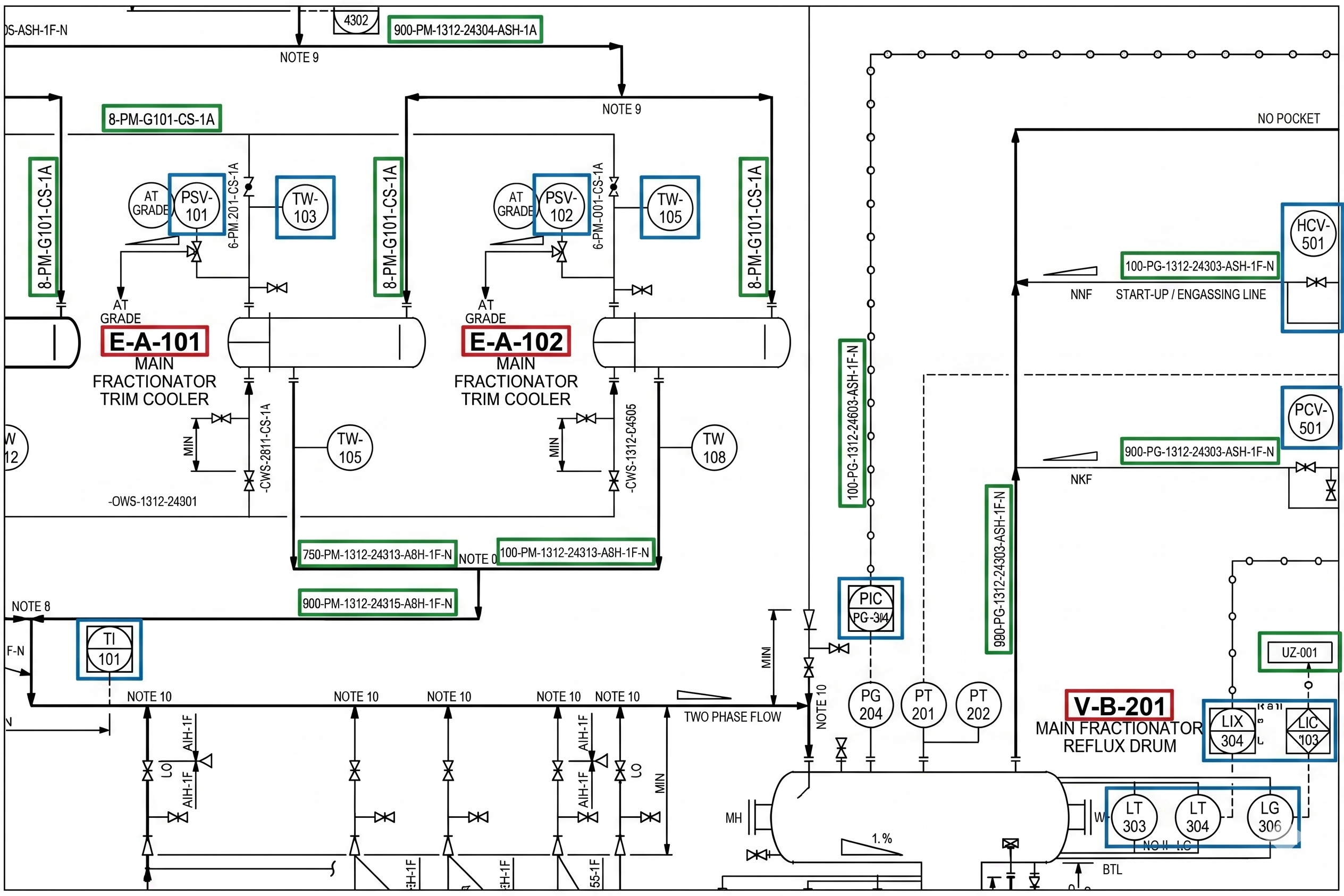
Intelligent Parsing of P&ID Engineering Drawings
Immediate Operational Capability with External AI Tools
In addition to the in-house developed tools, CTCI continues to survey and deploy external AI tools that can help improve its project operations. For example, these include AI tools based on Large Language Models (LLMs) such as Google Gemini, which possesses powerful multi-modal and logical reasoning capabilities; and Gemini Notebook (formerly NotebookLM), which specializes in high-accuracy document retrieval and integration.

1.Application of Gemini Notebook
In the engineering business, project success lies in understanding and following owner-specific requirements and international standards (such as ASME, API, ASTM). Gemini Notebook is valuable thanks to its "grounded generation" feature, which requires all generated responses to be based on the documents that the users uploaded. This perfectly aligns with the practice of "information source traceability" within the engineering sector.

According to CTCI’s verified application, during the bidding and initial design stages, engineers who face intricate contract clauses could import owner-specific requirements, documents from similar past projects, lessons learned, and relevant international standards into Gemini Notebook and generate an exclusive knowledge base. Unlike traditional AI, Gemini Notebook's responses are strictly limited to the scope of the provided documents, effectively avoiding risks of AI hallucination.

Through natural language inquiries, engineers can quickly sort out areas of conflict between owner requirements and international standards. AI tools rapidly summarize specific data and automatically annotate specific data sources, which minimizes the risk of rule omissions due to manual processing. In practical implementation, such applications have already significantly reduced the amount of time needed for technical bid document review from weeks to just a few days, demonstrating an impressive improvement in efficiency.

2.Application of Google Gemini
Google Gemini’s powerful generative capabilities and multi-modal parsing technology present immense value in engineering design output and cross-interface communication. In practical engineering, drawings, data reports, and technical descriptions are intertwined; Google Gemini is perfectly suited for handling such comprehensive tasks thanks to its capability to process text, data tables, and images simultaneously.

During the technical bid evaluation (TBE) phase of equipment procurement, engineers need to go through complex technical documents submitted by suppliers. Google Gemini can parse the equipment data sheet PDF files submitted by suppliers and instantly check whether key parameters (such as operating temperature, pressure, material grade, explosion-proof grade) conform to the specifications in CTCI’s request for quotation (RFQ). With multi-modal verification, the tool screens scanned documents, identifies table data, compares it with standard templates, and highlights non-conformance items from the supplier. This reduces the manpower cost for preliminary review and ensures that procurement decisions are based on accurate data comparisons.

In design operations, transforming data into technical descriptions is a tedious task. With Google Gemini, process engineers can easily draft up lengthy control narratives once they complete drawing drafts and instrument lists. This lowers the communication friction costs during cross-departmental or even cross-national collaboration, ensuring the consistency of technical documents.

3.Rearranging workflows with AI tool
With Google Gemini and Gemini Notebook, engineers can rearrange their workflow when processing information. Gemini Notebook can help locate important information among massive specifications and help identify risks. It transforms tens of thousands of pages of documents into "on-demand structured knowledge," solving the "where" problem. Once key information is located, Gemini takes over to perform logical reasoning, image-text comparison, and engineering document generation. This solves the "how" application problem.

AI has become an immensely valuable digital assistant for CTCI project teams. Gemini Notebook’s precise information locating capability and Google Gemini’s multi-modal generation allow engineering teams to significantly reduce repetitive workloads, enabling them to focus their energy on handling higher-value technical challenges and innovative designs.
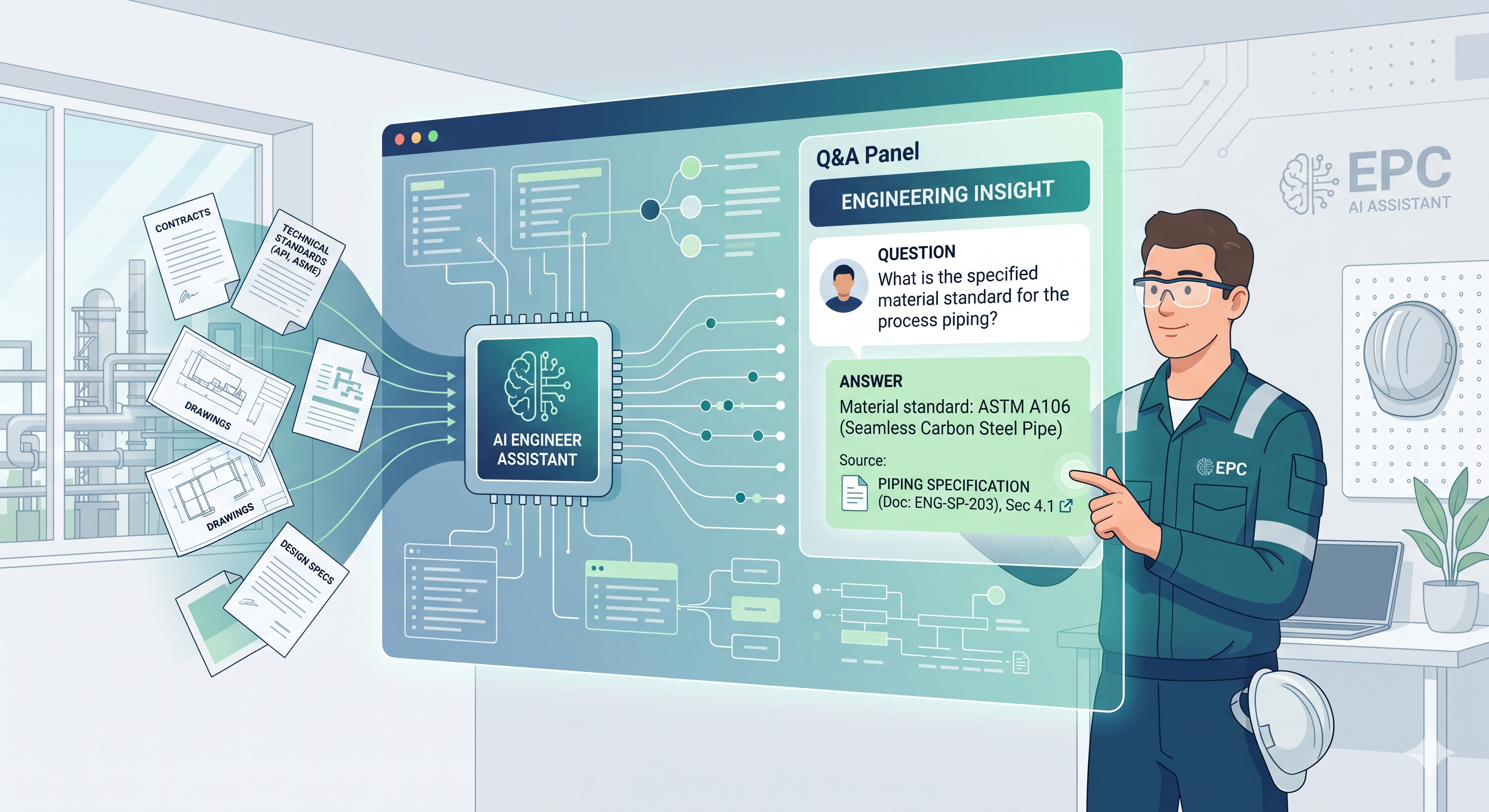
AI Tools Enable Engineers to Possess Immediate Operational Capability
Developing AI Literacy across the Group
From CTCI’s experience in AI deployment, the true challenge of AI lies not in the tools that it has introduced, but in whether its employees possess the "AI literacy" to master these powerful digital tools.

At its core, AI literacy requires engineers to profoundly recognize the capability boundaries of AI tools. For example, when engineers use AI to conduct preliminary stress analysis screening for piping materials, or carry out cross-national regulatory comparisons for contract terms, they need to be able to determine the quality of AI’s output. They should not blindly accept whatever output AI gives, and should instead become rigorous "validators". Outputs generated by LLMs may contain hallucinations or data analysis biases, and engineers with high AI literacy can quickly detect anomalies and conduct cross-comparisons based on their own profound engineering knowledge to ensure every output complies with international standards and project specifications.

As AI applications become more common, ethics and risk management stand out as paramount issues in corporate sustainable governance. It is necessary for companies that go through digital transformation to establish clear application boundaries and ethical baselines along the way. This includes ensuring the "fairness" of algorithms to avoid discriminatory decisions caused by biased training data; implementing "transparency" by requiring that the AI's logic be explainable and traceable when assisting with major engineering decisions (such as supplier selection); and strictly defining "accountability" by requiring sign-offs from human engineers and attributing ultimate responsibility to human engineers when defects or errors occur in AI judgments. At CTCI, we insist on engineering ethics not to hinder technological innovation but to ensure the sustainable development of technology.

AI literacy has become the cornerstone for sustainable corporate governance. While AI brings efficiency, it is necessary to continuously enhance engineers' AI literacy so that they retain independent judgment and risk prevention awareness, effectively avoiding risks while pursuing innovation, and paving the way for the company’s sustainable development.
Conclusion
For CTCI, the value of AI lies in strengthening the expertise and judgment of the team rather than replacing employees. As CTCI continues to deploy AI across engineering projects and corporate platforms, it will also continue to enhance the employees’ AI literacy and establish clear rules regarding AI application as well as define responsibilities, so as to balance the need for innovation and professionalism.

Looking to the future, CTCI will position itself with a forward-looking mindset and embrace industrial transformation brought by AI. Combining intelligent technology with engineering expertise and commitment to quality, CTCI is set to deliver more efficient, more reliable, and more intelligent engineering services.


