Sustainable Future
永續未來
Teaching Buildings to "Breathe": How AI-Powered Chiller Control Helps Companies Advance Toward a Sustainable Future
— Daniel Chang, Manager of Intelligent Products Department, CTCI ASI, Group Intelligent Solutions Business
As we step into a modern office building, the cool air that greets us often makes us forget the sweltering heat outside. Yet behind this comfort lies a striking fact: in commercial buildings, air-conditioning systems can account for more than 40% of total electricity consumption. This not only translates into significant operating costs, but also represents a major challenge for companies pursuing net-zero emissions and ESG goals.

To address this challenge, many companies have focused on supply-side solutions such as solar and wind power. At the same time, a quieter revolution is taking place on the demand side—using smart technologies to reduce energy consumption. This article shares how CTCI Advanced Systems Inc. (CTCI ASI), a CTCI Group company, applied an AI-Powered Chiller Control System at CTCI Group’s Second Headquarters to improve energy efficiency, reduce carbon emissions, and create greater sustainable value.
Energy Transition in Buildings: Opportunities for Smart Chiller Optimization
In commercial buildings, chillers are the heart of the HVAC system and among its most energy-intensive components. Conventional chiller control typically relies on fixed schedules or simple outdoor temperature and humidity settings to determine chilled-water supply temperature. This is much like asking a person to maintain the same heart rate whether jogging or sitting still. Even when indoor cooling demand decreases, the chiller may continue operating at unnecessarily low chilled-water temperatures, resulting in avoidable energy consumption and greenhouse gas emissions.

By introducing AI-powered control, the CTCI team effectively equips the building with a “brain” that improves energy efficiency while maintaining thermal comfort. Using machine-learning algorithms, the system analyzes multidimensional data collected from sensors across the building, including indoor and outdoor temperature and humidity, chilled-water flow rate, real-time cooling demand, and atmospheric enthalpy. Based on these data, the AI model predicts future cooling loads and continuously determines the optimal chilled-water supply temperature. This transforms chiller operation from reactive control to proactive prediction, automatically raising the chilled-water supply temperature during periods of lower demand to optimize the system’s coefficient of performance (COP).

In line with international guidance such as ASHRAE Standard 55, this AI control strategy is designed to reduce HVAC energy consumption while maintaining employee thermal comfort. It can therefore help lower operating costs, support ESG performance, and contribute to corporate sustainability goals.
Case Study: CTCI Group’s Second Headquarters—System Configuration and Control Mechanism
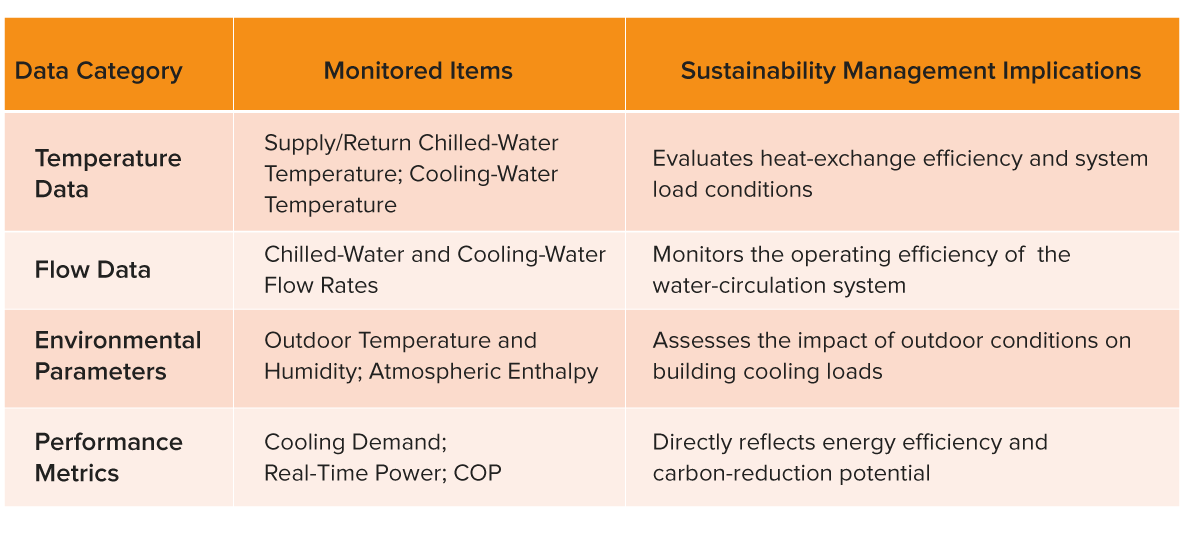
At CTCI Group’s Second Headquarters, the chilled-water system consists mainly of rooftop cooling towers, cooling-water pumps, chilled-water pumps, and three chillers (one 295 RT unit and two 450 RT units). Sensors installed throughout the system monitor four key categories of operational data in real time:
Under conventional control, the system frequently operated at a low chilled-water temperature setting of 7°C even during autumn, when cooling demand was relatively low. By making better use of historical operating data to predict cooling demand, the system can overcome one of the key limitations of conventional operation.
Building the AI-Powered Chiller Control Model
.Feature Engineering and Data Analysis: Historical operating data were extracted and analyzed using heat maps to identify strong correlations among chilled-water temperature, cooling-water temperature, and cooling demand.

.Deep Neural Network (DNN): A deep neural network with multiple hidden layers, batch normalization, and activation functions was adopted to capture the nonlinear relationships in chiller operation.

.Dynamic Optimization Control: The algorithm is based on the principle of raising the chilled-water supply temperature as much as operating load permits. Under suitable operating conditions, a higher chilled-water supply temperature can reduce chiller energy consumption. The AI performs real-time simulations and selects the optimal setpoint that balances thermal comfort and energy efficiency.
Model Predictions and Measured Energy-Saving Results
During a six-month simulation using historical data, the AI model reduced overall chiller-system electricity consumption by 3% by dynamically raising chilled-water temperatures, equivalent to a total savings of 3,740 kWh. Based on full-year operating data of 353,934 kWh, the estimated annual electricity savings are 10,618 kWh. A subsequent one-month field validation showed that the average COP increased from 9.64 without AI control to 9.95 with AI control, representing an improvement of approximately 3.2%.

Under high-load conditions, with cooling demand reaching 882–977 kW, conventional control lowered the chilled-water temperature to 8.1°C and power demand rose to 173 kW. With AI-based optimization, a chilled-water temperature of 9.4°C was sufficient to meet the cooling demand while reducing power demand to 167 kW, providing an additional energy-saving potential of approximately 3.5%.

The system also incorporates a retraining mechanism for continuous model improvement. When prediction accuracy is affected by equipment aging or seasonal changes, the latest operating data can be used to retrain the model and maintain stable long-term performance.

.Economic Benefits:The system is estimated to save approximately 10,618 kWh of electricity annually. At a commercial electricity rate of NT$4.5/kWh, this corresponds to annual electricity cost savings of approximately NT$47,800.

.Carbon Emissions Reduction Benefits:The estimated annual carbon reduction is approximately 4.1 metric tons of CO₂, based on the 2025 carbon emission factor of 0.388 kg CO₂/kWh.
Driving a Green Future through Intelligence
As a “Guardian of Sustainable Earth,” CTCI Group has long been committed to sustainable development. Through the research, development, and application of green technologies, CTCI continues to work with global clients and supply-chain partners to improve energy efficiency and reduce carbon emissions. In response to the AI era, CTCI has combined advanced intelligent technologies with practical building operations. Through the AI-Powered Chiller Control System, buildings can now “breathe” more intelligently by dynamically adjusting operation according to actual cooling demand. The system not only helps CTCI accelerate its own progress toward carbon reduction and net-zero goals, but also delivers measurable economic and carbon-reduction benefits. Looking ahead, the experience gained from this project can serve as a reference for future client projects, providing enterprises with a measurable, replicable, and sustainable pathway to green transformation. By harnessing the power of smart technologies, CTCI will continue to create greater value for its clients while contributing to a more sustainable future for the planet.