
Discover Reliable
發現信賴
CTCI Supports the High-Tech Industry in Advancing the Circular Economy: Taiwan's First In-Plant Waste IPA Concentration Process at a Semiconductor Facility
— Alex Chen, Executive Vice President of ECOVE Environment Services Corp., Group Resource Cycling Business
- Owner: A leading international semiconductor company
- Service Provider: ECOVE Environment Services Corp.
- Services: Professional Technical Services for an Isopropyl Alcohol (IPA) Concentration System
- Completion Date: May 2024
- Project Location:Taichung, Taiwan
- Project Scope: Engineering, Procurement, Construction, and Commissioning (EPCC)
- Treatment Capacity: 93 CMD
In recent years, rapid advances in artificial intelligence (AI) have continued to drive global semiconductor demand. As production capacity expands, the use of organic solvents such as isopropyl alcohol (IPA) in manufacturing processes has also increased significantly. In response to ESG and sustainable development trends, it has become a key priority for the semiconductor industry to effectively treat process waste solvents through resource recycling and reuse technologies to improve raw material utilization, reduce waste generation, and lower carbon emissions, so that the industry could enhance its sustainable competitiveness.

This article highlights how ECOVE Environment Services Corp., part of CTCI Group's Resource Cycling Business Group, leveraged its extensive experience and proven track record in recycling and reusing waste liquids from the high-tech industry to work with the client in establishing Taiwan's first in-plant waste IPA concentration system at a semiconductor facility. The system initially concentrates low-concentration waste IPA before it is sent to qualified reuse operators for further treatment, significantly reducing waste liquid volume and transportation costs, increasing resource circularity, and supporting energy conservation, carbon reduction, and waste minimization.
Why CTCI?
Extensive Expertise in the Circular Economy and Comprehensive Waste Solvent Treatment Capabilities
Established in 1994, ECOVE Environment Services Corp. (ECOVE ESC), a CTCI Group company, is one of Taiwan's leading service providers for the operation, maintenance, and management of environmental facilities. For more than 30 years, the company has focused on environmental facilities and developed extensive expertise in environmental engineering fields including incineration, resource recycling, and pollution prevention and control, with comprehensive capabilities in operation and maintenance, process optimization, and thermal treatment.

Drawing on decades of environmental engineering experience, ECOVE ESC has the capabilities to plan, design, and construct waste solvent recycling and treatment facilities. It can develop low-concentration waste solvent concentration and recovery systems tailored to client process requirements, which helps improve resource circularity, reduce waste treatment costs, and lower environmental impacts. This in turn allow clients to advance low-carbon manufacturing, the circular economy, and sustainable development.
Reliable Realized
Outstanding Engineering Quality Earns Client Recognition
In 2018, ECOVE ESC helped another Group company, ECOVE Solvent Recycling Corp. (ECOVE SRC), establish a waste solvent purification and recovery system. Since then, it has continued to invest in related technologies and process optimization, providing integrated solutions for the recycling and reuse of waste solvents, including waste IPA, for the semiconductor industry. Its services span preliminary planning, process design, equipment setup and installation, construction, commissioning and validation, and technical consulting, supported by extensive experience in design, construction, and operation.

For this project, HAZOP (Hazard and Operability Analysis) and LOPA (Layer of Protection Analysis) were applied during the design phase to systematically identify process deviations, potential hazards, and the effectiveness of layers of protection. The findings were then used to optimize process design, safety instrumentation, and operating strategies, reduce process risks, and ensure that the system met the high-tech industry's requirements for process safety and reliability. Furthermore, to address key issues such as plant layout, fire protection, construction safety, and the impact of construction on existing plant operations, multidisciplinary teams in process engineering, mechanical and electrical engineering, fire protection, environmental, health and safety (EHS), and engineering management jointly reviewed the design, construction strategy, and risk assessments to ensure that system planning addressed regulatory compliance, process safety, engineering quality, and functional requirements.

During the construction phase of this project, the team followed the engineering management objectives of delivering the required quality, on schedule, and within budget. Through comprehensive construction planning, engineering quality management, schedule management, cost control, and rigorous occupational safety management, the team ensured that the work met design requirements, remained on schedule, and stayed within budget, enabling successful project completion.

Before commissioning and startup, the engineering team followed Process Safety Management (PSM) principles and conducted a Pre-Startup Safety Review (PSSR), verifying item by item that equipment integrity, control systems, safeguards, and operating procedures met design requirements. This ensured safe, stable, and reliable operating conditions before the system was placed into service. The facility was successfully completed, demonstrating CTCI Group's commitment to being the "Most Reliable" service provider, and commenced formal operation in May 2024.
Innovative Technology
Application of Rotating Packed Bed Technology and Optimized System Design
The design of this project drew on the engineering track record and operating experience of ECOVE SRC's existing waste IPA concentration system and was optimized to suit the client's plant layout, architectural aesthetics, and process requirements. ECOVE SRC's existing system uses a tall distillation column to concentrate waste IPA from 10 wt% (weight percentage) to 80 wt%, while the rotating packed bed has primarily been used in extractive azeotropic distillation processes. In this project, rotating packed bed technology was extended to a low-concentration waste IPA Concentration System to replace conventional tall-column equipment, satisfying process requirements while accommodating plant space and architectural design constraints.

A Rotating Packed Bed (RPB) generates a high-gravity field that increases vapor-liquid contact area and mass-transfer efficiency, enabling separation performance comparable to conventional tall-column distillation in a much more compact unit. For this project, RPB concentration technology was adopted to meet the process requirements for waste isopropanol (IPA) concentration while improving vapor-liquid mass-transfer efficiency, optimizing plant space utilization, and increasing operating flexibility. Compared with conventional distillation column systems, the RPB offers a lower equipment height, smaller footprint, greater modularity, and shorter startup and shutdown times, reducing plant space requirements while providing greater flexibility for equipment layout and future expansion.
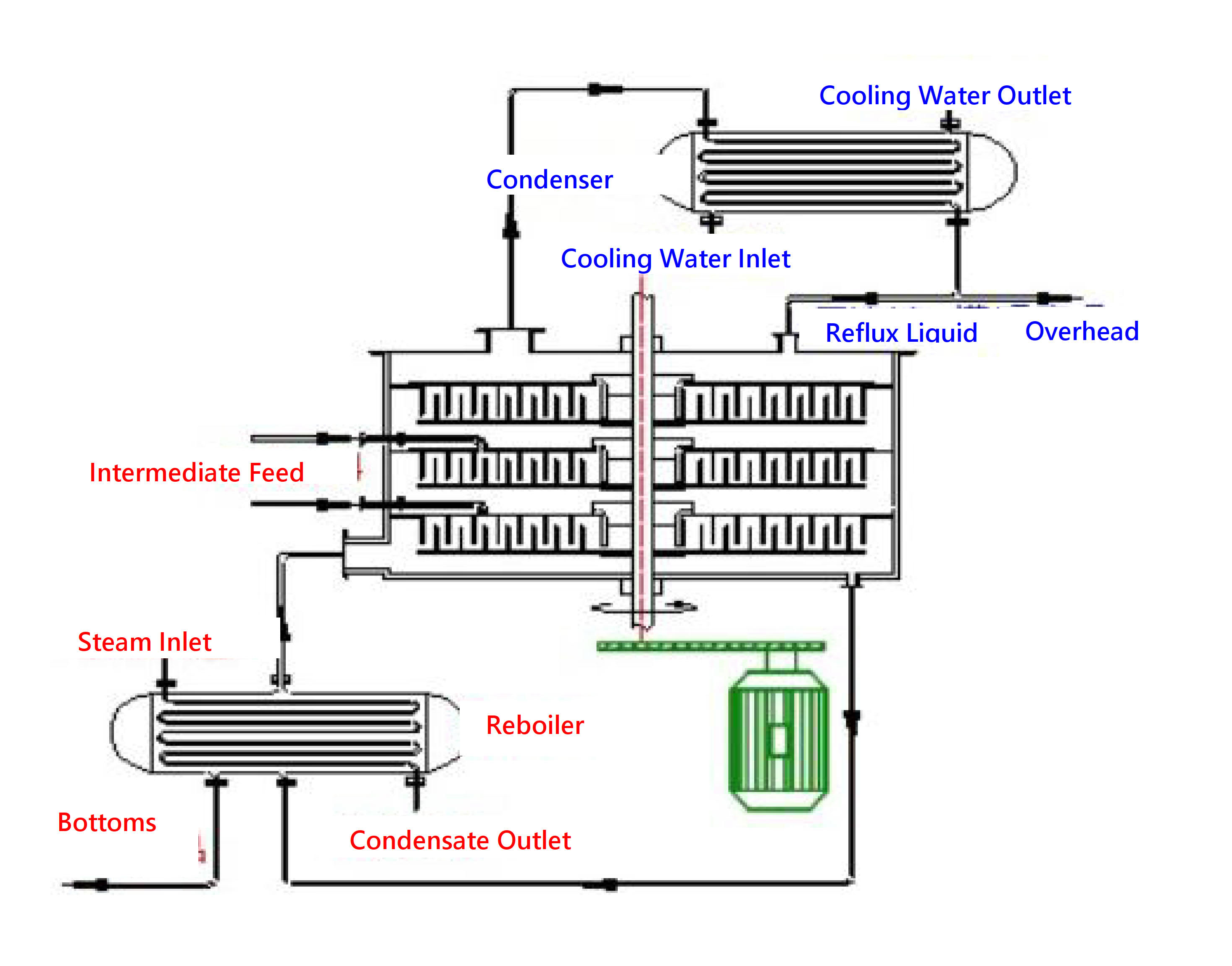
Process Schematic of the High-Gravity Distillation System
Project Highlights
Taiwan's First In-Plant Waste IPA Concentration System at a Semiconductor Facility
This project is Taiwan's first engineering application of an in-plant waste IPA concentration process at a semiconductor manufacturing facility, replacing the conventional model in which waste solvents must be transported off-site for treatment. It enables the client to establish an integrated circular system combining on-site concentration with off-site high-purity purification and reuse. Waste IPA generated by the process at a concentration of approximately 10 wt% is first treated by the on-site concentration system and then sent to ECOVE SRC for further high-purity purification and regeneration, creating an end-to-end resource circulation service model covering concentration, purification, recovery, and reuse.

This innovative model significantly reduces the volume of solvent waste requiring off-site transportation and treatment, improves resource circularity and overall economic benefits, and lowers the risks and carbon emissions associated with transporting hazardous materials, while addressing process safety, environmental protection, and operational needs. The project establishes a practical engineering example of in-plant solvent waste recycling and reuse for the semiconductor industry. It also serves as a reference for future resource circulation system planning, engineering implementation, and technology adoption across the high-tech sector, providing a concrete model for advancing the circular economy and sustainable development in the semiconductor industry.
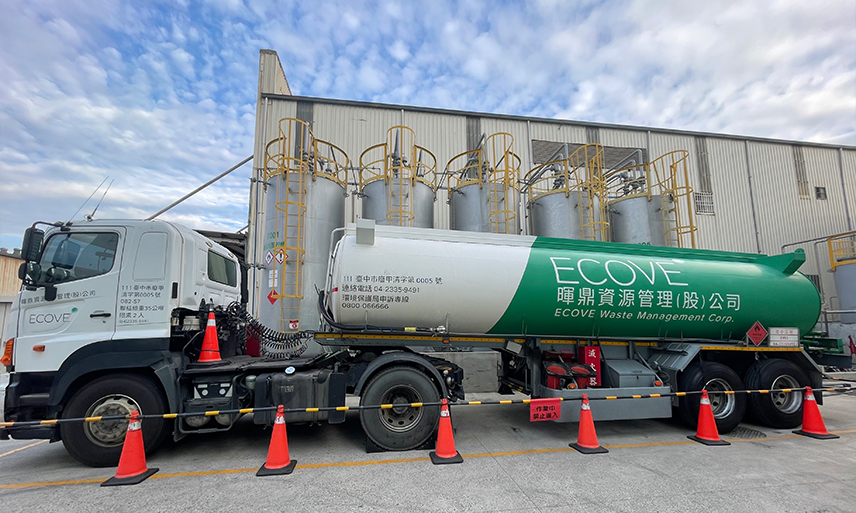
Concentrated IPA Received at the ECOVE SRC Plant for Purification and Recovery
Message from the Management Team
Contributing to the circular economy has become a key priority for high-tech manufacturers who wish to strengthen their sustainable competitiveness. In this regard, engineering technology is essential to putting resource circulation into practice. ECOVE ESC will continue to invest in R&D for solvent waste recycling and reuse technologies as well as invest in engineering innovation. Drawing on its accumulated experience in design, construction, and operation, ECOVE ESC will help clients develop resource circulation systems that deliver safety, efficiency, and environmental benefits, promote the sustainable use of resources, and work with industry toward low-carbon manufacturing and sustainable development.


