
CTCI Family
CTCI地球村
Broadening My Perspectives Through Experience
— Nawarat Paengsutto, Instrument & Control Engineer, CTCI Thailand
Hello, my name is Nawarat Paengsutto (Pattie). I am an Instrument & Control Engineer at CTCI Thailand. I come from Roi Et, a peaceful province in northeastern Thailand located approximately 500 kilometers from the nation’s capital, Bangkok. Compared to bustling major cities, Roi Et has a calm atmosphere and abundant green public spaces. The most iconic landmark of Roi Et is the Ho Whod Tower (Roi Et Tower) which is shaped like a whod, a traditional Isan bamboo mouth organ. The 35-story architecture design pays tribute to the region’s rich musical heritage, while the tower itself serves as both a cultural landmark and a recreational space. Visitors can enjoy a panoramic view of the city from the top or take an exciting ride on the zipline that speeds down and across the park’s pond. This memorable, relaxed, and charming place is where I spent my high school years.
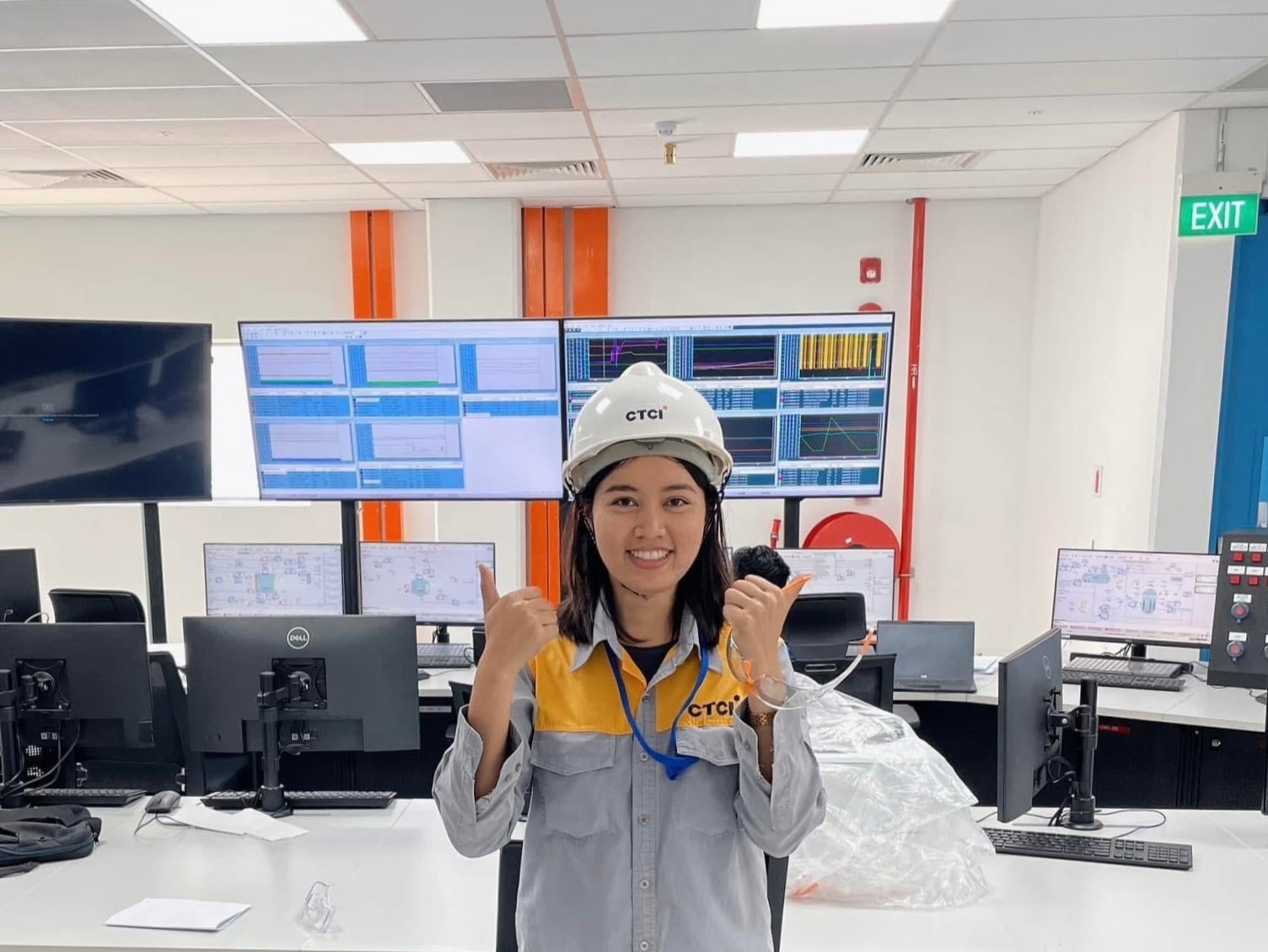
My favorite and most familiar place at work: the control room.
Stepping into the Fascinating World of Instrumentation and Control
I have been interested in mathematics and physics since high school, always enjoying the process of understanding the world in a logical, structured way. Early on, I realized that an “invisible system” is at work behind every complex industrial process, quietly ensuring that everything runs safely and smoothly. This fascination led me to study instrumentation and control (I&C) engineering at King Mongkut’s Institute of Technology Ladkrabang (KMITL) in Bangkok. After graduation, I gained some industry experience before successfully applying for an I&C engineering role at CTCI Thailand. Once I joined, I discovered a company deeply anchored by long-serving, experienced colleagues that offers diverse career opportunities, ranging from design work to site assignments and international projects.

I&C engineering is about ensuring all process measurements and control requirements are accurately translated from engineering designs into real, field-installed systems. It plays a pivotal role in maintaining consistency across disciplines—such as process, mechanical, electrical, and vendor package systems—so that the entire facility functions as a fully integrated system. By properly selecting, installing, and configuring instruments, the I&C team contributes to a plant’s operational reliability and maintainability.

As an I&C engineer, my responsibilities span detailed design engineering, instrument specifications, and control systems. I participate in various stages of an engineering, procurement, and construction (EPC) project. During the engineering stage, I prepare instrument datasheets, drawings, and design documents. In the construction stage, I coordinate with supervisors and troubleshoot issues. Finally, during the commissioning stage, I support commissioning activities in the field for instrument devices and the control room for DCS, SIS, FGS, and PLC systems.

Among the many instruments that I work with, I am particularly drawn to control valves. They are critical components in a petrochemical plant, directly regulating key process variables like flow, pressure, temperature, and level. Any instability in a control valve can quickly impact process performance, product quality, and overall plant safety. I am also interested in plant control and safety systems, including the DCS, SIS, FGS, and PLC systems. Under normal conditions, these systems continuously monitor and control the process; during abnormal or emergency situations, they initiate protective actions—such as valve shutdowns—to bring the plant to safe state and minimize risk.
Overcoming Overseas Challenges, Building Global Friendships
When I look back on my most memorable experiences at CTCI Thailand, the Saffron-B project instantly comes to mind. This was an EPC project in Singapore for SABIC, involving the construction of a large-scale specialty polymer plant designed to produce high-performance ULTEM™ resin. I was deployed to the field as a Field Instrument & Control Engineer. Even though my assignment lasted less than a year, the demanding work and advanced technical requirements helped me grow tremendously both professionally and personally.

The biggest hurdles were adapting to a new working style and communicating in a foreign language. In my previous projects in Thailand, I usually followed the workflow from the early engineering and procurement stages through the Factory Acceptance Test (FAT) and Integrated Factory Acceptance Test (IFAT), and I could communicate comfortably in Thai—my mother tongue—with colleagues, supervisors, and construction workers. For the Saffron-B project, however, I joined at a much later stage: site installation, Site Acceptance Test (SAT)/Integrated Site Acceptance Test (ISAT), and pre-commissioning. This meant I had to quickly catch up on the project’s history and grasp ongoing issues under tight timelines. Furthermore, because my team members came from diverse backgrounds—including Singapore, Taiwan, Malaysia, and India—everyone brought unique communication styles. This required extra care and clear verification to avoid misunderstandings. Fortunately, one by one, these challenges were overcome.

This overseas assignment was an invaluable experience that allowed me to collaborate with a multicultural team and build lasting relationships. The teamwork, mutual support, and shared experiences made my journey truly special and deeply meaningful. Even though we have all returned to our respective home countries as the assignment ended, our friendship remains. As this chapter comes to a close, another one begins. I am now embarking on a new adventure at the Ras Laffan Petrochemical project (RLPP) in Qatar, and I hope our paths will cross someday.
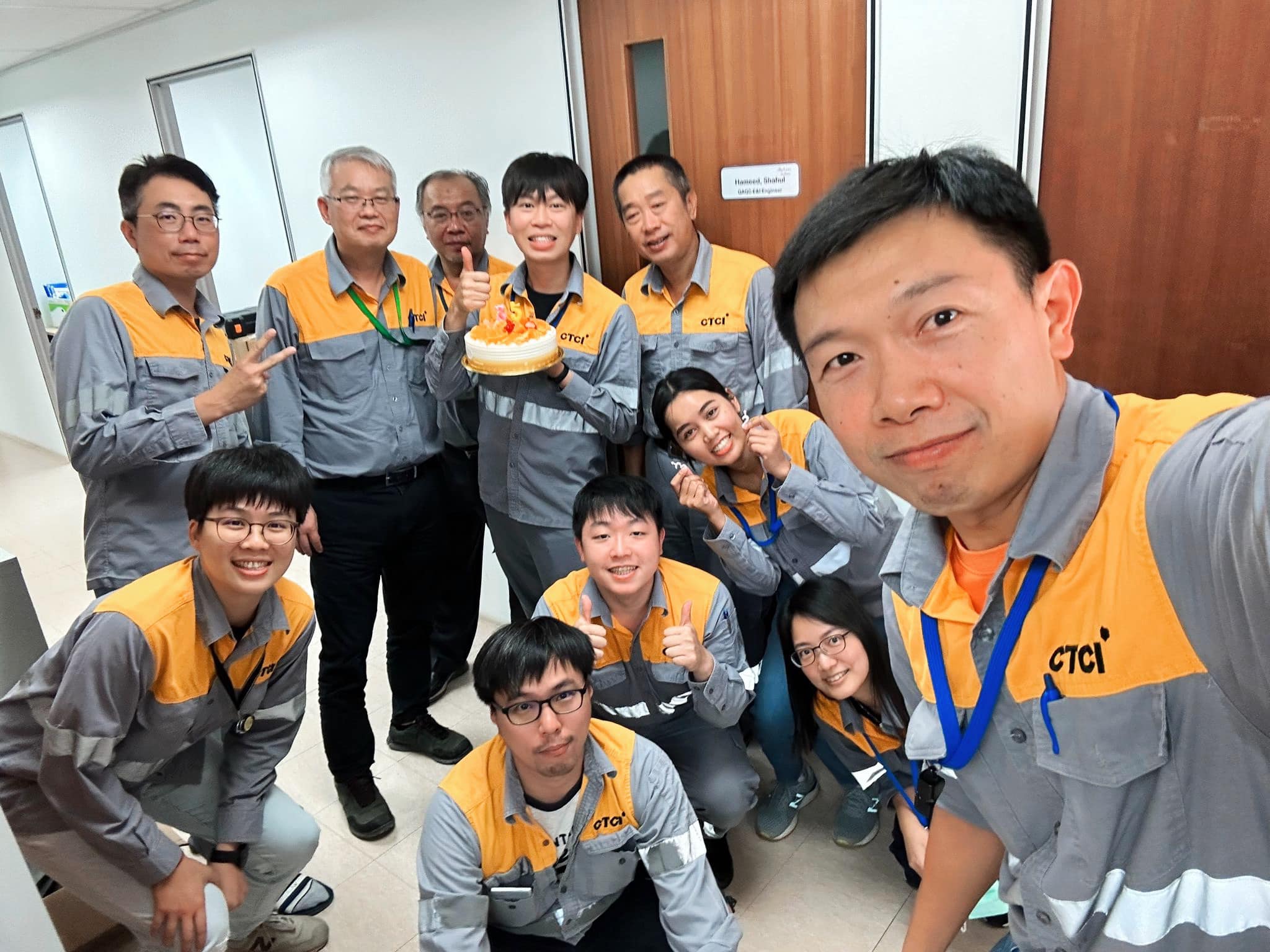
A heart-warming birthday celebration moment at the construction site.


