Discover Reliable
發現信賴
A Storage Facility Built by CTCI for Diverse Artwork Collections: Introducing Taipei Fine Arts Museum New Collection Vault EPC Project
Ren Huang, Project Manager at CTCI SEC, Group Intelligent Solutions Business
- Market category: Public project (cultural & arts facilities)
- Owner:First District Project Office, Department of Rapid Transit Systems, Taipei City Government
- End user: Taipei Fine Arts Museum
- Execution units: Joyear Construction Company / CTCI Smart Engineering Corporation (CTCI SEC) / Shu Chang & Associates, Architects
- Completion date:December 2023
- Project location: Taipei City
- Scope:Engineering, procurement, and construction (EPC)
The Taipei Fine Arts Museum (TFAM) New Collection Vault EPC project was commissioned by TFAM to Taipei City Government’s First District Project Office of the Department of Rapid Transit Systems to significantly increase the museum’s collections storage capacity and provide a preservation environment with precise temperature and humidity controls tailored to various media and artistic materials. The new facility helps enhance the maintenance, research, and display of diverse collections—including painting, calligraphy, sculpture, photography, and prints—thereby promoting art history research, education, and international exchange.

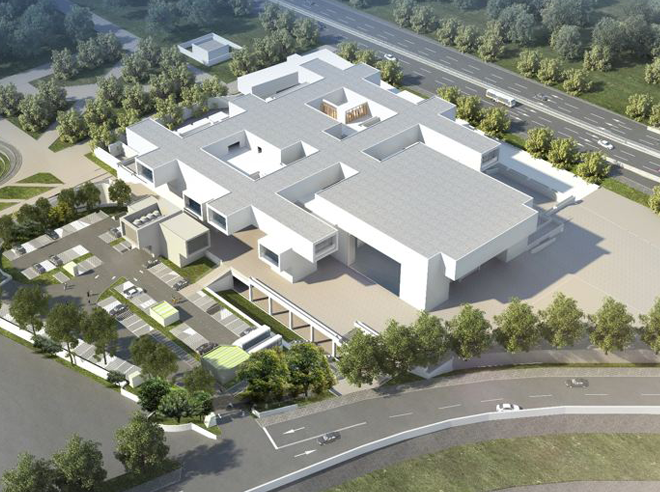
CTCI Smart Engineering Corporation (CTCI SEC), a member of CTCI’s Group Intelligent Solutions Business, joined hands with Joyear Construction and Shu Chang & Associates to win the bid. Located at the site of the existing museum parking lot, the collections vault design included a two-story underground warehouse and a multi-functional restoration room. The south entrance and parts of the existing facility were also renovated. By integrating with the existing storage space and optimizing environmental control conditions, the new design offered the best stability and security for the collections.
Why CTCI?
As the top EPC group in Taiwan and among the world’s top 100, CTCI has long been recognized for its "Most Reliable" engineering and construction quality and long-term commitment to sustainability. Its affiliated company, CTCI SEC, possesses extensive experience and a proven track record in MEP (mechanical, electrical, and plumbing) and HVAC. It is an award-winning company for outstanding engineering quality, including the recent execution of the residential turnkey project north of Central Village in Xindian District, which was given the Public Construction Golden Quality Award. During the TFAM project’s bidding process, CTCI SEC, together with Joyear Construction and Shu Chang & Associates, formed an optimal team. They were selected as the best qualified contractor for their comprehensive design planning and construction service proposal.
Reliable Realized
First Foray into Cultural Public Works, Earning High Recognition
As a member of CTCI’s Group Intelligent Solutions Business, CTCI SEC undertakes domestic and international engineering services, offering the "Most Reliable" project management and EPC services, including intelligent engineering solutions to clients with high-tech/biotech facilities, high-rise buildings, and public infrastructure needs.

This project marks CTCI SEC’s first foray into public construction for the cultural and arts sector. The team conducted a thorough analysis of the specific requirements for the museum warehouse—including constant temperature and humidity, fire safety, anti-theft measures, and energy efficiency—as well as the site's environmental characteristics. By leveraging its professional MEP and HVAC turnkey design capabilities, CTCI SEC successfully created a high-quality environment for art preservation, earning high praise from the client.
Project Highlights
Leveraging MEP Expertise for Optimal Collections Preservation
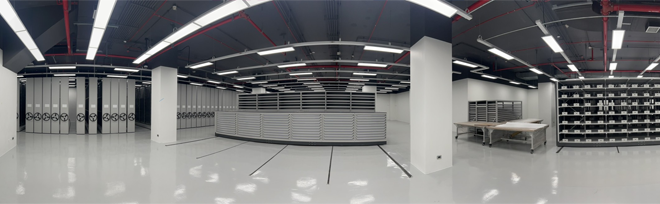
Based on its MEP and HVAC expertise, CTCI SEC fully evaluated the diverse needs of the storage warehouse, artifact restoration, display spaces, fire safety, and access control. Referencing international standards for collection preservation, the team developed an integrated plan tailored to the characteristics of the artifacts, which took into account the specific requirements for different materials and sizes, strict temperature and humidity standards, organic gas circulation and filtration, and low-UV fluorescent lighting. The goal was to minimize deterioration caused by environmental factors and disasters. In the end, the project created a premium preservation environment that supported sustainability principles, allowing the new collections vault to obtain the Bronze Level Green Building Label from the Taiwan Architecture & Building Center.
Innovative Technology
Advanced Fire Warning System for Stringent Safety Requirements
In addition to constant temperature and humidity requirements, fire safety facility planning is critical given the large volume of paper-based artifacts in the collection. The sensitivity and levels of standard fire smoke detectors are generally defined by smoke density. Ordinary photoelectric alarms have a sensitivity range of approximately 0.005% obs/m (0.0015% obs/ft.) *, which typically detects smoke at the initial stage of cable or equipment overheating.
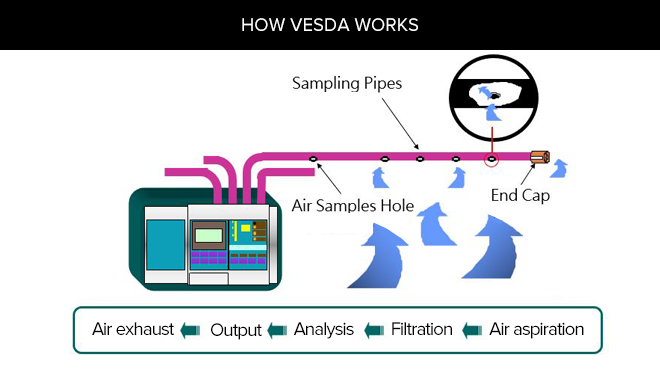
To detect fires as early as possible and achieve precise control, the collections vault project implemented the very early smoke detection apparatus (VESDA) system, which has a wider sensitivity range (0.001-20.0% obs/m), in all collection warehouses and inside high/low-voltage switchgear panels in electrical rooms. The project also implemented the aspiration smoke detector (ASD) system, which would actively and continuously draw air samples 24 hours a day to monitor suspended particles. When smoke is  detected, the system will immediately emit alarm signals, buying valuable time during the initial stages of a fire.

Furthermore, the VESDA system is combined with laser detection technology and advanced air particle analysis to precisely detect minute amounts of smoke and potential fire signs. It features auto-calibration, intelligent control, and remote monitoring to ensure stable operation and immediate troubleshooting. Through flexible settings for multi-level, staged alarms, the system can detect anomalies and trigger warnings even when just a tiny amount of smoke is present—before a fire breaks out—helping users control the situation early and avoid damage.
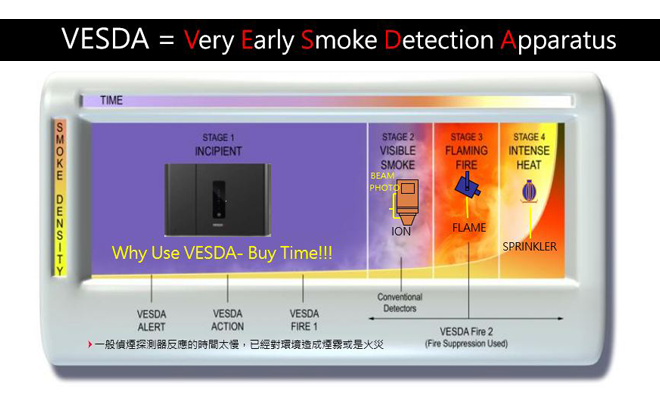
To maximize VESDA's effectiveness, the project team held intensive design and technical meetings with manufacturers and the client during the planning phase. The team looked at the airflow distribution within protected zones and evaluated the capture of air samples containing combustion particles based on the number of sampling holes, their sensitivity, and cumulative effects. The team also determined the quantity and location of sampling holes according to VESDA's detection capacity (vertical or horizontal pipes).

Ultimately, the project team was able to attain the original goal of design and planning through sound analysis, integration of air supply and return vents in the storage spaces, and the use of a low-pollution, gaseous fire suppression system. From system integration planning and installation to final functional testing, the system effectively fulfilled its function of accurate and very early fire warning.
* obs/m = Obscuration per meter, indicating the degree to which light is obscured by smoke for every meter it travels.
Message from the Project Team
This project represented CTCI SEC's first venture into the cultural and arts engineering sector. Despite the challenges of labor shortages due to the COVID-19 pandemic and inflation, the project was completed by the end of 2023. Following a successful 180-day settling period for HVAC trial operations, we have established a world-class collections warehouse for the cultural assets of Taipei, demonstrating CTCI SEC’s EPC strengths that combine technical prowess with sustainable concepts.